

Komodo Island gives the national park its name, and for most visitors it means one thing: landing at Loh Liang and walking inland with a guide.
What that walk involves is more variable than most people expect. There is more than one route; they differ in length and effort, and the choice may depend on the time available and the route arrangement on the day. This guide covers what the island is, what happens when you land, and how to think about the walking options.
For the wider picture, see our Komodo National Park section.
What Komodo Island is
Komodo Island sits in the middle of the national park, between the mainland of Flores to the east and Sumbawa to the west. It is the largest of the park’s islands and gives the park and the animal their name.
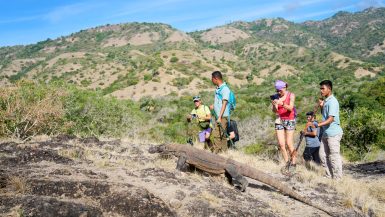
The landscape is dry. Steep hills covered in savanna grass run down to the coast, with pockets of denser vegetation in the valleys and a scatter of trees on the slopes. It looks brown for much of the year and green after rain.
For visitors, the island is reached at Loh Liang, on the eastern side. This is the park’s main visitor entry point and the base for what a day visitor does here. For most visitors, Loh Liang is the main arrival point on Komodo Island.
Arriving at Loh Liang
You arrive by boat. There is a jetty, a ranger post, and an area where groups gather before walking.
The pattern is consistent: boats moor or anchor offshore, visitors come ashore, and groups are formed at the arrival area before setting out. Visitors walk accompanied by a guide rather than independently, and a briefing on conduct and what to expect precedes the walk.
The transition from boat to trail is quick. Loh Liang is an arrival point rather than a place to spend time in its own right, and most of a visit is the walk itself.
Choosing a walking route
This is the part worth understanding before you land, because route choice is one of the main practical decisions involved in the visit.
Shorter and longer walking options are commonly described for Loh Liang, but the current route structure is not confirmed by an official park source. Published descriptions vary between sources, and some are years old. Rather than repeat route numbers or distances that may be outdated, what follows describes the options by character.
Shorter routes
Shorter options are generally described as involving less walking and less sustained exertion than longer alternatives. They may suit visitors with limited time ashore, anyone unsure about heat or exertion, and mixed groups where pace has to work for everyone.
Cruise-ship visitors, in particular, typically make half-day visits and use shorter routes, which is worth knowing because Loh Liang can be busy with sizeable groups on those routes.
Longer routes
Longer options involve more walking and more sustained physical effort, with terrain and exposure varying along the route.
The trade-off is not simply more scenery. Longer routes take you further from the arrival area and across more varied terrain, which is the appeal for people who want the walk itself rather than a short excursion.
How to choose
A few considerations settle it for most people.
How long you have ashore. This is usually decided by your boat’s schedule rather than by you, so it is worth asking before you arrive.
Heat. The island is dry and largely unshaded, and the middle of the day is hot. A longer route in full sun is a different proposition from the same route earlier in the morning.
Fitness and group composition. Longer routes involve sustained walking on uneven ground. A group with children, older travellers, or anyone unsteady on rough surfaces will usually be better served by a shorter option.
What you actually want. If you are here principally to see the island rather than to walk it, the shorter route does that. If the walk is the point, the longer route is the reason to allow more time ashore.
Where route choice is available, the options can be discussed with your guide at the arrival area, so it is worth knowing what kind of walk suits your group before you get there.
What the walk involves
The walking at Loh Liang is on trails rather than open hillside, but the ground is natural and uneven in places, with loose surfaces on the slopes.
Shade is limited. The savanna offers little cover, and the trees are scattered rather than continuous. The heat is the main practical consideration, and it builds as the morning goes on.
Gradients vary with the route. The shorter options stay relatively gentle; the longer ones climb.
Practical points that follow from that: closed footwear with reasonable grip is more comfortable than sandals, water is worth carrying, and sun cover is worth having.
You walk with a guide throughout and stay with your group, which sets the pace as much as your own fitness does.
Dragons on Komodo Island
Komodo dragons live on the island, and observing them is why most visitors come.
That subject has its own page. Where observation is permitted, what the park requires of visitors, and what determines whether you see one are covered in our guide to where dragons can be observed.
For the purposes of this page, two things are worth saying. Observation happens along the guided walking routes rather than anywhere on the island. And the animals are wild, so an encounter is not something any route or operator can promise.
Kampung Komodo
There is a settlement on Komodo Island, Kampung Komodo, whose residents live and fish in the area.
Whether visits to the village form part of routine tourist access is not something we have been able to establish from a current official source, and we are not going to assume it. If a village visit matters to you, ask your operator whether it is included in what you have booked rather than expecting it as part of a Loh Liang visit.
What Loh Liang has
Loh Liang functions as the park’s main entry point, with a jetty, a ranger post and an arrival area where visitors gather before walking.
Beyond that, we are not describing facilities we cannot currently verify. Reports of what is available on site vary, and some are dated. Plan on the basis that you bring what you need for the walk and return to your boat afterwards, and confirm anything else with your operator.
How access is managed
Visiting Komodo National Park is now subject to a visitor quota, in force since 1 April 2026, applying across the park’s nature tourism sites including Loh Liang. Reservation through the park’s official platform is required before entering, subject to the quota available for the day.
Loh Liang does not operate the timed visiting sessions used at Padar. Those sessions are a Padar arrangement. At Loh Liang the quota applies, but visitors are not allocated to fixed time slots in the same way.
Our guide to park entry and reservations covers how booking works.
Two further points. Cruise-ship visitors have been counted under a separate quota since April 2026, and cruise guests visit Loh Liang and Loh Buaya but are not permitted at Padar. And the quota policy has been the subject of active discussion in Labuan Bajo, with the park authority describing it as still under evaluation.
Check the current position before you travel. This is the most changeable thing on this page.
How Komodo Island fits into a trip
Komodo Island is reached by boat from Labuan Bajo and appears on most multi-day itineraries in the park, generally alongside Padar and one or more snorkelling stops.
Where it falls in a given trip, and how much time you have ashore, is set by the itinerary rather than by the island. Our guide to Komodo itineraries covers how trips are commonly structured.
The practical planning point is the one from the route section: the length of your walk depends on how long your boat allows ashore, and that is worth asking about before the day.
Frequently asked questions
Guided walking from Loh Liang is the main visitor activity, with wildlife observation along the routes. It is not an island with a range of separate attractions.
That depends on your itinerary and which route you walk. Shorter routes suit a brief stop; longer routes need more time ashore. Ask your operator how long the visit allows before choosing.
No. Visitors walk accompanied by a guide and stay with their group.
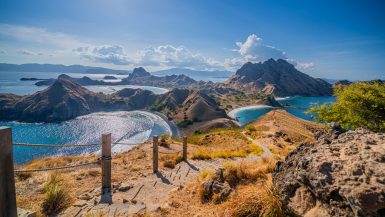
They involve different kinds of walking. Padar is a sustained climb to a viewpoint, while Komodo Island offers different walking options at Loh Liang. The more useful comparison is the type and length of walk you are comfortable with rather than which island is harder.
Yes. A visitor quota applies across the park’s sites, and a reservation through the official platform is required before entry, subject to availability.
Leave a reply