
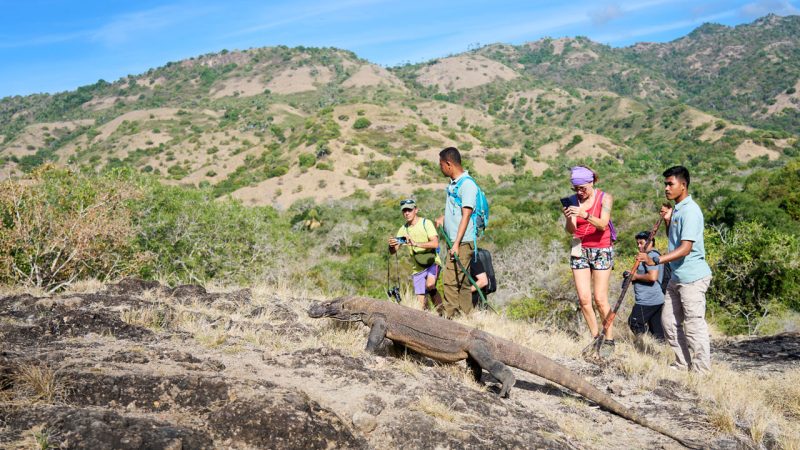
Komodo dragons live across several islands in Komodo National Park, but you cannot look for them wherever you like. Observation happens at a small number of designated sites, on marked routes, accompanied by a guide.
That is worth knowing before you book, because it changes the question. It is not “where in the park are the dragons”, but “which of the designated sites will my trip visit, and what does a visit there involve”.
This guide covers where observation is permitted, what the park requires of visitors, what a trek involves, how the sites differ, and why nobody can promise you an encounter. For the wider picture, see our Komodo National Park section.
Where observation is permitted
The park’s official visitor information says that visitors who want to observe Komodo dragons directly are directed to certain guard resorts opened for tourism activity. It names three: Loh Buaya on Rinca Island, Loh Liang on Komodo Island, and Padar Selatan on Padar Island.
This is the part most guides get wrong. The question is usually presented as a choice between two islands. Officially there are three designated resorts, and they do not serve the same purpose.
Loh Liang, Komodo Island
Loh Liang is the visitor resort on Komodo Island itself, and the site most people picture when they think of seeing dragons. It functions as a main entry point to the park, with a ranger post, marked trekking routes, and basic visitor facilities.
Trekking routes here vary in length, so what your visit involves depends partly on which route your group takes.
Loh Buaya, Rinca Island
Loh Buaya is the visitor resort on Rinca. Provincial and park sources treat it and Loh Liang as the two zones used for dragon observation.
Park material describes Loh Buaya as a destination favoured by visitors for three reasons: adequate nature tourism facilities, a high likelihood of encountering dragons and other wildlife, and its relative proximity to Labuan Bajo. That is the park’s own characterisation rather than a guarantee, and it is the closest thing to an official statement on encounter likelihood that this guide found.
Its trekking route reopened in 2023 after site redevelopment.
Padar Selatan
Padar Selatan is a designated observation resort, and it is not the same kind of site as the other two.
Padar is overwhelmingly visited for its summit panorama rather than for wildlife. Park material describing visits there refers to briefings that include not feeding wild animals that may be encountered on the trekking route, so encounters are possible. But the visit is structured around the viewpoint; guides work to a defined route with set stopping points, and time at the summit is managed.
Treat Padar Selatan as a designated resort where dragons may be seen, not as a dragon-trekking destination equivalent to Loh Liang or Loh Buaya. If seeing dragons is your priority, a trip that includes only Padar is not the same as one that includes a dedicated trek.
What the park requires of visitors
Observation is a managed activity, not a walk you take on your own.
Visits to the observation areas are managed with Naturalist Guides or park staff. Visitors are expected to stay with the group and follow the guide’s directions along the permitted route.
You stay on the permitted route. Park material describes guides directing visitors along authorised trekking paths, with interpretation at designated stopping points. Leaving the group or wandering off the route is not permitted.
Conduct rules apply on the trail. Reporting on the park’s rules for the reopened Rinca route recorded that visitors may not run on the trail, may not take close-range photographs with the animals, may not make excessive noise, and may not remove natural objects. Feeding wildlife is prohibited. Drone use requires prior permission and is restricted.
Group sizes and guide ratios are also set by the park. Published figures for these date from earlier arrangements and are not confirmed as current, so this guide does not state them. Your operator or the park should be able to confirm what applies on the day.
Park entry itself is arranged separately, and our guide to park fees and permits covers how that works.
What a dragon trek involves
A trek at one of these sites is a guided walk on a marked trail, not an expedition.
You arrive by boat, are met at the resort, receive a briefing on conduct and safety, then walk the route with your guide, who stops at points along the way to explain what you are looking at. Routes are generally short by hiking standards, and the terrain is uneven in places.
Dragons, when present, are usually observed at a distance from the trail. The guide sets that distance, and following their direction is the point of the accompaniment.
The whole thing is a modest part of a day rather than an all-day undertaking, which is why it fits inside a boat itinerary alongside several other stops.
How the sites differ
Because the sites are not interchangeable, the comparison matters more than a simple island choice.
Purpose. Loh Liang and Loh Buaya are the two resorts treated as the tourism zones for dragon observation. Padar Selatan is a designated resort where dragons may be encountered, but its visitor activity is built around the summit route.
Encounter likelihood. Park material describes Loh Buaya as offering a high likelihood of encountering dragons and other wildlife. No comparable official characterisation was found for the other sites, which does not mean encounters are less likely elsewhere — only that it is not stated.
Distance from Labuan Bajo. Rinca sits closer to town than Komodo Island. Park material cites that proximity as one reason Loh Buaya is favoured. In practice, this affects how a site fits into a trip more than it affects the visit itself.
Facilities. Both main resorts have ranger posts and visitor facilities. Park material specifically notes the adequacy of facilities at Loh Buaya.
Other wildlife. These sites are habitat for more than dragons. Park material notes wildlife encounters generally, and the yellow-crested cockatoo is recorded as living across the park, including Rinca and Komodo Island.
What operators include. Itineraries differ on which resort they use for the dragon trek. That is an operator decision rather than a park one, and it is worth asking before booking. Our guide to Komodo itineraries covers how the trek fits into a trip.
What affects whether you see one
Dragons are wild animals in a large park, and their movements are their own.
What can be said is that observation is organised: the sites exist because they are places where encounters have historically been reasonably common, and guides know the routes and the animals’ habits. That is why the park manages observation at these locations rather than allowing visitors to search freely.
Beyond that, this guide does not publish predictors. You will find pages stating that dragons are more active at particular hours or in particular months. No park or scientific source supporting those claims was found, and repeating them would mean presenting an operator’s impression as a rule. Activity varies. Weather, temperature and the animals’ own behaviour all play a part, and none of it is something a visitor can schedule around with confidence.
Conditions can also affect whether a stop happens at all, since access depends on the sea. Our guide to the best time to visit covers how conditions vary through the year.
Why no one can promise you a sighting
Operators frequently write as though an encounter is part of what you are buying. The park itself does not.
The park’s own wording refers to visitors who are fortunate to be able to observe dragons directly. That is the managing authority declining to guarantee the outcome, in its own published material, and it is a more honest starting point than anything a booking page will tell you.
This is not a warning that you probably will not see one. Encounters at the main observation resorts are common enough that the sites exist for the purpose. It is a caution about how the trip is sold: an itinerary can promise to take you to a place where dragons live, and no more than that.
If a page or an operator guarantees a sighting, they are describing something they do not control.
Choosing between the sites
Most visitors do not choose directly. The trek is part of a boat itinerary, and the operator has already decided which resort it uses. So the practical question is which itinerary you book.
If seeing dragons is the priority, look for an itinerary that includes a dedicated trek at Loh Liang or Loh Buaya, rather than assuming any park visit will provide one.
If your itinerary includes Padar only, understand what that means. You will visit a designated resort where dragons may be encountered, but the activity is built around the summit route.
If proximity matters, Rinca is closer to Labuan Bajo, which is one reason Loh Buaya features in shorter trips.
If you want to see both main resorts, that generally means a longer trip, since they sit on different islands.
Ask which resort your trek uses. It is a reasonable question, and an operator who cannot answer it clearly has told you something.
Frequently asked questions
At designated observation resorts inside Komodo National Park. The park names three: Loh Buaya on Rinca, Loh Liang on Komodo Island, and Padar Selatan on Padar. The park’s official visitor information identifies designated observation resorts rather than allowing visitors to search for dragons freely across the park.
Both Loh Liang and Loh Buaya are treated as observation zones. Park material notes Loh Buaya’s facilities and its relative proximity to Labuan Bajo, which is one reason it features in shorter trips. No comparable official statement was found for Loh Liang, which is not the same as saying encounters are less likely there.
Padar Selatan is a designated observation resort, and encounters are possible on its trekking route. But Padar is visited mainly for its summit panorama, and a visit there is not equivalent to a dedicated dragon trek.
Visitors should expect guided and managed access at the observation sites. You are required to follow the directions of the Naturalist Guide or park staff and stay on the permitted route.
No. The park’s own material refers to fortunate visitors being able to observe them. The park identifies the resorts as places for direct observation, but an encounter is still not guaranteed.
Leave a reply