
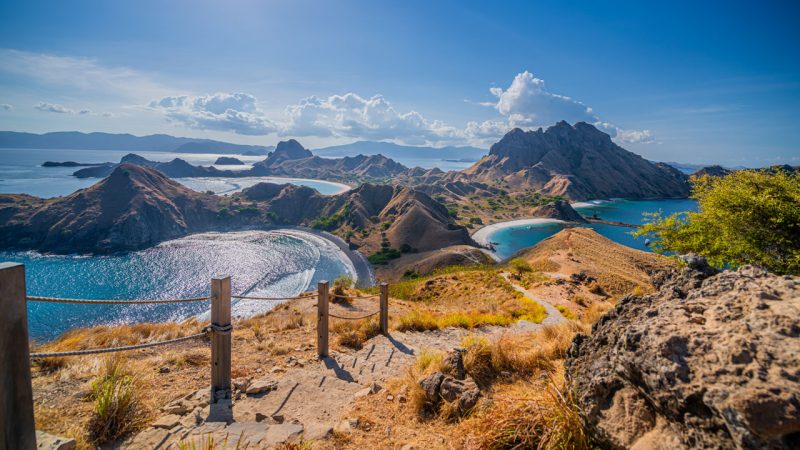
Padar is best known for the view from its ridge, where several curving bays come into view beneath the island’s steep hills.
This guide is about the visit rather than the view. What the climb involves, how access is now managed, why even the number of steps is disputed, and what determines whether you reach the top at the hour you were picturing.
For the wider picture, see our Komodo National Park section.
What Padar is
Padar is an island within Komodo National Park, lying between Komodo Island and Rinca. It is the third largest island in the park, and unlike its two neighbours, it is visited almost entirely for its landscape rather than its wildlife.
The reason is a single viewpoint. A ridge rises behind the landing point, and from the top the island’s shape becomes visible: several bays cutting into the land from different directions, separated by steep hills, with the beaches of each bay differing in colour.
Getting to that viewpoint is the visit. There is no settlement on Padar and limited visitor infrastructure, and trips return to the boat after the climb.
The climb to the viewpoint
What the path is like
The route to the viewpoint is a constructed path built by the park authority, not an open hillside. It begins near the landing point and climbs the ridge in a series of steps.
The surface changes as you go. The first stretch beyond the ticket post is wooden, and the longer section above it is built from a cement, sand, and stone mix. Near the top, the constructed steps end, and the final short section is over bare rock.
Shade is minimal. There are a few trees along the route and little else, so the climb is exposed for most of its length.
How long it takes
Around 45 minutes to the top is the figure most commonly reported, and it takes longer in heat. That is a walking time for the ascent alone, not the whole visit, which includes coming down and getting back to the boat.
Treat it as approximate. Pace varies with fitness, temperature, and how busy the path is.
Why the step count is disputed
Almost every page about Padar tells you exactly how many steps there are. They do not agree.
Published figures differ by several dozen steps, and the disagreement is not only between travel sites. The Indonesian government’s own published figure differs from the numbers reported by national media, which in turn differ from each other. Some counts appear to date from before the path was completed; others may count different sections.
We have not resolved it, and we are not going to pick one. There is no basis for choosing between them, and stating a precise number would mean presenting a guess with more confidence than any of the sources deserve.
For that reason, an exact step count is less useful than understanding the nature of the climb: a sustained ascent, stepped for most of its length, taking around three quarters of an hour.
How hard is it?
This is the more useful question, and the honest answer is that it depends more on conditions than on fitness.
The climb is short by hiking standards but continuously uphill, on steps of uneven height, with little flat ground to recover on. There is almost no shade, and reported walking times lengthen in hot conditions. Later in the morning, the path is hot and fully exposed.
The final rock section requires more care than the stepped part, particularly coming down.
Who tends to find it demanding: anyone unused to sustained ascent, anyone affected by heat, and anyone with a condition that makes exertion difficult. Suitable footwear is worth considering given the steps and the rock section, and water is not available on the island.
None of this makes it a technical climb. It is a steep set of steps in a hot place, and knowing that in advance is most of the preparation.
How access is managed
Access to Padar is managed through a visitor quota and session system rather than being open to anyone who arrives.
Since 1 April 2026, Komodo National Park has applied a visitor quota, reported by park officials as an annual figure of around 365,000 and managed as a daily average in the region of 1,000 people. Park officials have described unused capacity in quieter periods being redistributed to busier ones, so daily numbers are not a fixed cap. Padar is one of the sites specifically covered.
Visiting Padar has been organized into three visiting sessions each day, covering morning, midday and afternoon. Booking is handled through the park’s official reservation platform, which also shows availability.
Published figures for how many visitors each session admits vary between sources, and so do the site-specific limits reported for Padar. We are not publishing per-session numbers, because the sources conflict and the arrangement has changed more than once in the past year.
What is consistent is the structure: a daily limit, three sessions, and booking in advance. The consequence is real. In April 2026, national reporting described visitors being refused the summit climb because the day’s quota was already full, and that was outside peak season.
Our guide to park entry and reservations covers how booking and entry work.
Re-check current arrangements before you travel. This is the most volatile thing on this page.
Sunrise, and whether you will get it
Sunrise at Padar is the version of this place that circulates most widely, and it is the source of a good deal of disappointment.
Reaching the viewpoint at first light is possible. An early session makes a pre-dawn arrival achievable for trips that are already positioned nearby.
Whether your trip gets there is a different question, and it depends on three things that have nothing to do with Padar itself: whether your itinerary includes an overnight leg positioning the boat close by, whether your booking falls in the earliest session, and what conditions allow on the day.
Operators differ on how they handle this, and some have an interest in the answer. If a sunrise climb is the reason you are going, ask directly which session your trip is booked into rather than assuming an early departure guarantees it.
Conditions matter as well, and our guide to the best time to visit covers how they vary through the year.
Nobody can promise you the light. What can be established in advance is whether your trip is structured to be there when it happens.
What the island does and does not have
Padar has a landing point, a ticket post, and the constructed path. Visitor infrastructure beyond that is limited.
There is no overnight accommodation for visitors, and trips return to the boat after the climb rather than relying on facilities on the island. Bring what you need for the climb, particularly water, and take it back down with you.
The practical consequence is that your visit is bounded by your boat’s schedule.
Wildlife on Padar
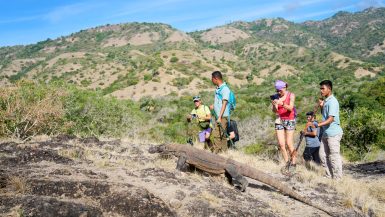
Komodo dragons are present on Padar, and the island sits within the same protected area as Komodo and Rinca.
They are not, however, why people come here, and they are not routinely encountered on the trekking route. Padar’s visitor activity is built around the viewpoint.
If seeing dragons is a priority for your trip, that is a separate question with a separate answer, covered in our guide to where dragons can be observed.
Staying on the marked path is expected regardless.
How Padar fits into a trip
Padar is reached by boat from Labuan Bajo and appears on most multi-day itineraries in the park, usually early in the day.
Where it falls in a given trip, and whether that placement allows an early session, depends on the itinerary rather than on the island. Our guide to Komodo itineraries covers how trips are commonly structured and what varies between them.
The practical point for planning: Padar’s session system means the timing of your visit is set when you book, not on the day. That makes it worth asking about earlier than most parts of a trip.
Frequently asked questions
Published figures disagree, including between official and media sources, and differ by several dozen steps. We do not publish a number because there is no reliable basis for choosing between them. The ascent is sustained and stepped for most of its length.
Around 45 minutes to the viewpoint is the figure most commonly reported, longer in the heat. That covers the ascent only.
It is short but continuously uphill on uneven steps, with almost no shade. Heat can make the ascent considerably more demanding, particularly when the route is exposed and conditions are hot. The final section above the constructed steps is over bare rock and needs more care, especially descending.
Yes. Access is managed through a visitor quota and three visiting sessions, booked through the park’s official reservation platform. Visitors have been turned away when the available quota for a day was already taken.
The earliest session begins before dawn, so it is possible. Whether your trip reaches the viewpoint at first light depends on your itinerary, which session you are booked into, and conditions on the day. It is worth confirming with your operator rather than assuming.
They are present on the island but are not routinely encountered on the trekking route, and Padar is visited for its viewpoint rather than for wildlife.
Leave a reply