
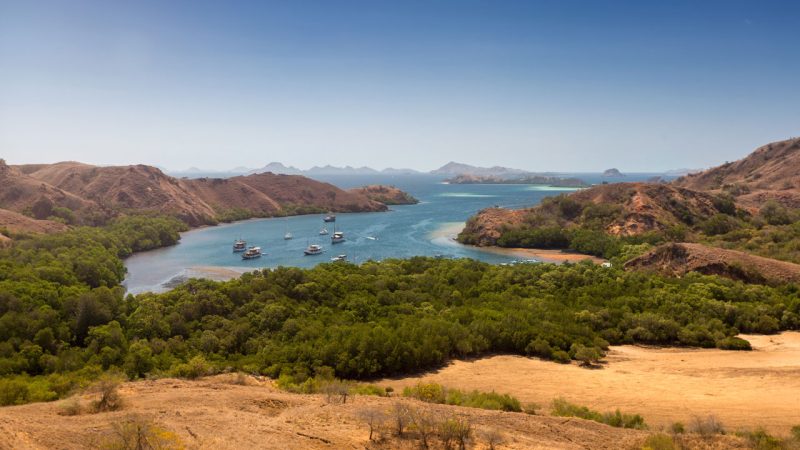
Rinca Island is one of the three major islands of Komodo National Park, alongside Komodo and Padar, according to UNESCO. This page is about the island itself: its place in the park, the visitor site at Loh Buaya, and the wildlife recorded on Rinca besides Komodo dragons.
If seeing dragons is your main interest, our guide to where Komodo dragons can be seen covers that in full. For the park as a whole, see our Komodo National Park guide.
Rinca Island at a glance
- Part of the national park. UNESCO describes Komodo National Park as made up of three major islands, Rinca, Komodo and Padar, and numerous smaller ones.
- Protected since 1938. According to the park authority’s history of the park, Rinca was designated a wildlife sanctuary in 1938, alongside Padar, before the national park was designated in 1980.
- Loh Buaya. The visitor resort on Rinca is Loh Buaya, which the park authority’s website lists as a trekking destination.
Rinca is one of the places covered in our guide to the islands of Komodo National Park.
Loh Buaya: the visitor site
Two dated accounts describe aspects of the redevelopment of Loh Buaya and the wider Rinca Island visitor area. The two accounts below come from different sources and different years, and they describe different things.
The 2020 plan. In October 2020, Indonesia’s Cabinet Secretariat, drawing on information from the Ministry of Public Works and Housing, described redevelopment works on Rinca Island. The one item it placed specifically at Loh Buaya was an upgrade of the existing pier. The wider plan for Rinca also included:
- a coastal protection structure that would also serve as a footpath;
- an elevated deck on the existing route, designed to stand two metres high so as not to disturb Komodo dragons and other animals;
- an information centre integrated with the elevated deck, combining a resort office, guest house and cafeteria;
- lodging for rangers, guides and researchers.
These were works described at the time of planning and construction, not a record of what was finally built.
The 2023 report. In February 2023, detikBali reported on the site. The report described an elevated walkway of about 300 metres running from the pier towards the visitor-site area and connecting it with lodging. It also passed the mangroves along the way. The report describes it as replacing an earlier, lower concrete path that flooded at high tide. A guide quoted in the report, Emanuel Bangu, recalled that visitors previously walked below.
These descriptions date from 2020 and 2023. Current facilities and arrangements at Loh Buaya are not confirmed here.
Wildlife beyond the dragons
The Rinca rat. The park authority, Balai Taman Nasional Komodo (BTNK), records a species it calls the Rinca rat (tikus Rinca). On its wildlife page, BTNK says the Rinca rat can be found at the Loh Buaya resort and describes it as a very large rat, with BTNK giving its size as approximately 30–40 cm. BTNK states that it is found only on Rinca and lists it among the park’s endemic animals.
The dhole. BTNK also says the dhole (ajag), a wild dog, can be found on Rinca.
Birds. BTNK records the yellow-crested cockatoo as living naturally on Rinca, as well as on Komodo and Bero.
Mangroves. The park authority’s description of the park’s ecosystems notes mangroves in the south of Rinca.
Dragons on Rinca
Rinca is one of the islands in the park where Komodo dragons live, according to BTNK, and Loh Buaya is one of the park’s designated observation sites. Where and how dragons can be seen, what the park requires of visitors, and how Rinca compares with Komodo Island are covered in our guide to where Komodo dragons can be seen.
Frequently asked questions
Yes. UNESCO describes Rinca as one of the park’s three major islands, and the park authority records it as a wildlife sanctuary from 1938.
Loh Buaya is the visitor resort on Rinca, listed by the park authority as a trekking destination. In 2023, detikBali reported an elevated walkway there of about 300 metres. Current facilities are not confirmed here.
The park authority records the Rinca rat, which it says is found only on Rinca, and the dhole, a wild dog.
Leave a reply