
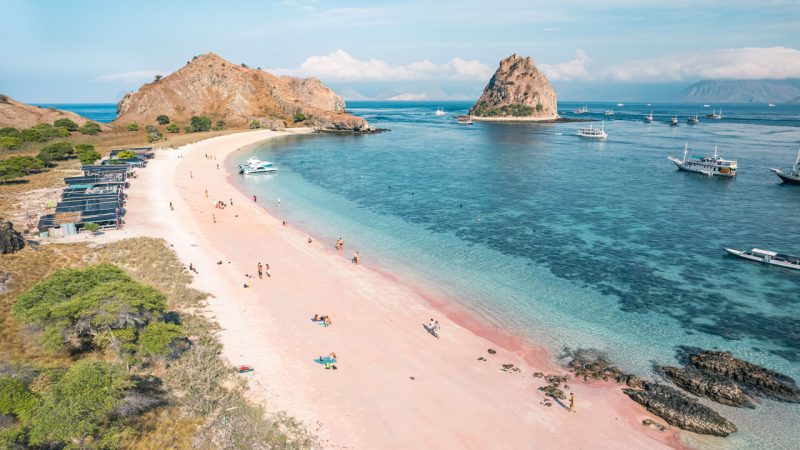
Pink Beach in Komodo National Park is one of the tourism destinations listed by the park authority. This page covers what the beach is, why its sand looks pink, and what published sources say about where it is, a point on which they disagree.
Pink Beach is one of the places covered in our guide to the islands of Komodo National Park.
What Pink Beach is
The park authority, Balai Taman Nasional Komodo (BTNK), includes Pink Beach on its destination list, with the activity label “Sunbathing dan Snorkeling”. The listing gives the beach’s name and activities but does not say which island it is on.
Indonesia’s Ministry of Tourism also refers to it by its Indonesian name, Pantai Merah.
For the park as a whole, see our Komodo National Park guide.
Why the sand looks pink
According to Indonesia’s Ministry of Tourism, the pink colour comes from microscopic organisms called foraminifera. A second Ministry article describes the sand as white sand mixed with reddish coral fragments, linked to foraminifera that produce a red pigment.
Other published accounts explain it differently:
- CNN Indonesia, in May 2025, gave foraminifera as the cause, and also cited Lonely Planet’s explanation that the colour comes from decomposed red organ-pipe coral.
- Tempo, in August 2025, described crushed coral fragments together with foraminifera.
- In October 2015, ANTARA quoted a local guide who attributed the colour to red coral.
No scientific study of this particular beach’s sand was found when this page was checked. These are the explanations published sources give, not an established account of what colours this beach.
Which island is Pink Beach on? What sources say
Published sources disagree about which island Pink Beach is on. This page sets out what each says and does not decide between them.
| Placed on | Source | Date |
|---|---|---|
| Komodo Island | Ministry of Tourism, “Planning to explore Pink Beach? Learn these 5 things first” | Undated |
| Komodo Island | Ministry of Tourism, Pink Beach destination page | Undated |
| Komodo Island | ANTARA | 29 October 2015 |
| Padar (north-west) | CNN Indonesia | 26 May 2025 |
| Padar | Tempo | 19 August 2025 |
The park authority’s destination list names Pink Beach but does not say which island it is on.
Separately, the Ministry of Tourism describes a “baby pink sandy beach” on Padar in an article on island hopping in Komodo National Park.
The park authority documents most likely to settle the question could not be read when this page was checked, so the location remains unresolved here.
For the islands themselves, see our guides to Komodo Island and Padar Island.
Planning a visit: where to read more
- Snorkelling: conditions across the park are covered in our guide to snorkelling in Komodo National Park.
- Sand and coral: the park authority’s visitor protocol prohibits taking sand, coral or other objects from the park without written permission, and the Ministry of Tourism asks visitors not to take sand, coral or marine life as souvenirs. Our guide to Komodo National Park rules covers the protocol.
- Komodo dragons: see our guide to where Komodo dragons can be seen.
- Fees, quotas and access: see our guide to park fees and permits.
- When to go: see our guide to the best time to visit.
- Where a stop fits in a trip: see our Komodo itineraries.
Frequently asked questions
The Ministry of Tourism attributes the colour to foraminifera, microscopic organisms. That is the Ministry’s explanation, not a confirmed finding for this beach. Other published accounts mention coral fragments or organ-pipe coral. No scientific study of this particular beach’s sand was found.
Published sources disagree. The Ministry of Tourism and ANTARA (2015) place it on Komodo Island, while CNN Indonesia and Tempo (2025) place it on Padar. The park authority’s destination list does not say.
The park authority lists Pink Beach among the park’s tourism destinations.
Published sources describe Pink Beach’s sand as naturally pink and offer several explanations for its colour. However, no scientific study of this particular beach’s sand was found.
Leave a reply