
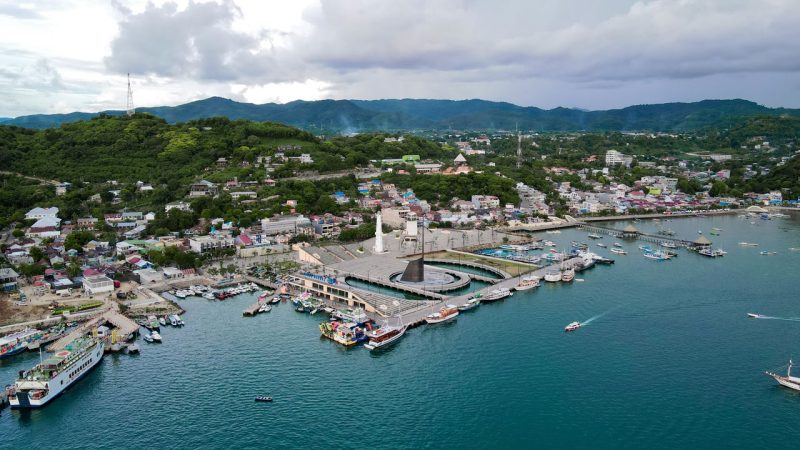
Labuan Bajo is the town almost every Komodo trip starts from, on the western tip of Flores. Getting there is straightforward, but it is rarely a single journey, and the part that catches people out is not the flying. It is the connection, and what happens if it slips.
This guide covers the ways into Labuan Bajo by air and by sea, how the connections fit together, how long the journey actually takes once everything is counted, and why the gap between arriving and boarding a boat matters more than most people expect.
Routes and services change. Anything specific here is current as of the verification date above, and worth checking again when you book. For the wider picture of the town itself, see our Labuan Bajo section.
The short version
Fly. For almost everyone, that means one flight to a major Indonesian airport and a second to Labuan Bajo, most commonly connecting through Bali.
A ferry route exists and is used, but it involves reaching Sumbawa first, so it suits travellers already moving overland rather than those arriving by air.
Allow more time than the flight schedule suggests, and leave a clear buffer between landing and any boat departure.
Flying to Labuan Bajo
Komodo Airport
Labuan Bajo is served by Komodo Airport, code LBJ, also recorded as Mutiara II. It sits close to the town on the western end of Flores, and it is the only airport serving the area.
There is no airport inside Komodo National Park. The park is reached by boat from Labuan Bajo, which is why the town functions as the base for the whole region.
The airport holds international status and has been expanded and upgraded since 2019, when Labuan Bajo was designated one of Indonesia’s five super-priority tourism destinations. The nearest alternative airports, Ruteng and Tambolaka, are some distance away and are rarely useful to visitors heading for Komodo.
Where flights come from
Labuan Bajo is connected to a growing number of Indonesian cities. As of the verification date above, direct domestic services included routes from Bali, Jakarta, Surabaya, Lombok, Kupang, Makassar, Maumere and Ende, among others.
That is a set of examples rather than a complete list, and it changes. A route to Tambolaka began operating in July 2026, which is a fair illustration of how quickly any published list dates. Check current options when you book rather than relying on a guide, including this one.
Two qualifications are worth carrying into your planning.
Bali, Jakarta and Lombok are among the main connection points. They can offer several onward options, but the best choice depends on where your first flight arrives and which connection leaves enough room for delays.
Some routes are seasonal. The Surabaya service, for instance, has operated from July to October rather than year-round. If you are planning outside the middle of the year, confirm that the route you are counting on is running in your month.
Most travellers still reach Labuan Bajo via an Indonesian connection, although direct international services can operate on selected routes and can change over time. It is worth a search from your own departure point before assuming two flights are unavoidable.
Connecting through Bali
Bali is one of the most common connection points, especially for international travellers. Denpasar handles the widest range of international arrivals, and the onward leg to Labuan Bajo is short, generally in the region of an hour and a half.
The practical effect is that most international travellers arrive in Bali, then take a domestic flight east. Whether you break the journey with a night in Bali or connect the same day is a decision worth making deliberately rather than by default, and the next section covers why.
Connecting through Jakarta
Jakarta is the alternative, and it suits travellers whose international flight arrives there anyway or who find better onward timings. Direct services to Labuan Bajo operate from Jakarta, and the flying time is longer than from Bali since the distance is greater.
Neither gateway is better in the abstract. What matters is which one your international arrival fits, and how much slack the connection leaves you.
Reaching Labuan Bajo by sea
There is a genuine sea route, and it is used regularly by Indonesians travelling between the islands.
A roll-on/roll-off ferry operated by the state ferry company connects Sape, in Bima regency on the island of Sumbawa, with Labuan Bajo. It carries passengers and vehicles, and the crossing has been reported as taking up to around eight hours, though this varies with conditions and load. Passenger ships also connect Bima with Labuan Bajo.
Ticketing arrangements have varied over time, including which routes can be booked online, so check the current position rather than assuming.
The sea route is a real transport option, but for travellers arriving by air it is usually a much longer journey, because reaching Sape requires crossing Sumbawa first. That means an overland and inter-island chain from Bali or Lombok before the ferry even begins.
It makes good sense in two situations: if you are already travelling overland through Lombok and Sumbawa and want to continue rather than backtrack to an airport, or if you are bringing a vehicle. For a traveller flying into Indonesia with a fixed number of days, it is a considerable detour rather than an alternative to a short flight.
How long the journey really takes
This is where planning most often goes wrong, because flight time and journey time are different things.
The flight from Bali to Labuan Bajo is short. The journey from your home airport to your accommodation in Labuan Bajo is not.
Count the whole thing:
- The international flight into Indonesia
- Time on the ground between flights, including immigration, baggage, and any terminal change
- The domestic flight east
- Getting from Komodo Airport into town
A long-haul arrival followed by a same-day connection can easily consume a full day and part of the next, depending on timings. Travellers arriving from within Asia may find it fits into one long day. Those coming from further away frequently do not.
The useful question is not how long the flight is, but what time you will realistically be in Labuan Bajo with your bags — and whether that leaves anything usable of the day.
Allowing enough time for the connection
This section matters more than anything else on the page.
Komodo boat trips generally leave early from Labuan Bajo, so a delayed flight can mean missing the departure. A day trip in particular departs at the start of the day, which means a flight arriving that morning offers no margin at all.
Several things can go wrong with an itinerary that has no slack:
Delays. Domestic services can be delayed for operational or weather reasons, and a delay of a few hours is enough to miss a morning departure entirely.
Separate tickets. If your international and domestic flights are booked separately, a missed connection may leave you responsible for rearranging the onward journey and any resulting costs.
Weather. Conditions affect both flights and boats. Our guide to the best time to visit covers how they vary through the year.
The practical answer is to arrive the day before any boat departure. A night in Labuan Bajo before an early start costs one evening and removes most of the risk from the trip you have come for.
This applies with particular force to day trips, which leave earliest and return the same evening. Overnight trips also depart in the morning, so the same logic holds.
Arriving in Labuan Bajo
Komodo Airport is close to the town, and the transfer is short. Onward transport is available on arrival, and hotels frequently arrange pickups.
Once you are in town, everything to do with the park happens by boat, and departures leave from the harbour. Our Boat Trips section covers the options and what to check before booking one.
If you are arriving with a boat trip already booked for the following morning, two things are worth doing on the day you land: confirm the departure time and meeting point with your operator, and find out how long it takes to get from where you are staying to the harbour.
Choosing the route that fits your trip
Flying via Bali suits most international travellers. It offers the widest choice of arrival options and the shortest onward leg.
Flying via Jakarta suits travellers whose international flight lands there, or who find the onward timings work better.
Arriving by sea suits travellers already moving overland through Lombok and Sumbawa, or bringing a vehicle. It is a substantial journey undertaken for its own sake rather than a shortcut.
Whichever you choose, the planning question is the same: what time will you actually be in Labuan Bajo, and how much room does that leave before the boat goes?
Frequently asked questions
Komodo Airport in Labuan Bajo, code LBJ. It is the only airport serving the area, and there is no airport inside the national park itself.
By direct flight from Denpasar, generally around an hour and a half. It is the most common route and usually offers the widest choice of timings.
Most travellers still reach Labuan Bajo via an Indonesian connection, although direct international services can operate on selected routes and can change over time. It is worth checking from your departure point rather than assuming.
Yes. A roll-on/roll-off ferry connects Sape, on Sumbawa, with Labuan Bajo, and passenger ships link Bima with the town. Reaching Sape means crossing Sumbawa first, so it is a long journey for anyone arriving by air.
Arrive at least the day before. Boats generally leave early, so a delayed flight can mean missing the departure, and a missed departure is difficult to recover from within a short trip.
Leave a reply