
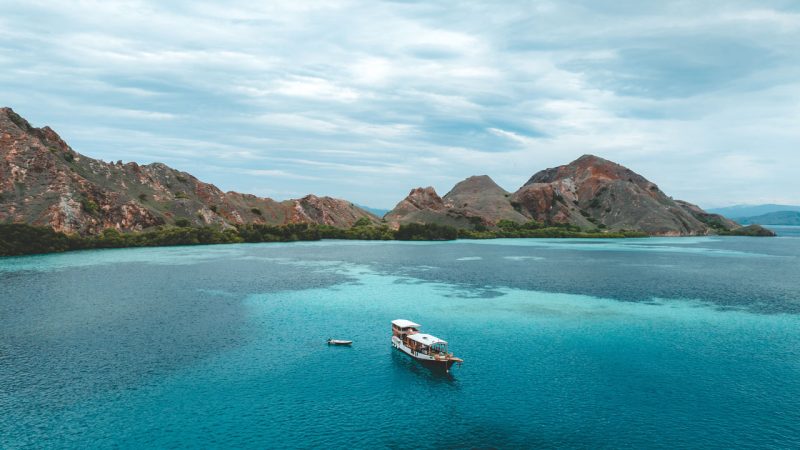
Diving is one of the main activities in the waters of Komodo National Park. This page is an orientation to diving in Komodo, not a dive-site guide. It covers what the diving involves, the park authority’s rules that apply to divers, what to check about a dive operator, insurance, and how long to wait before flying.
Where information comes from the park authority, Balai Taman Nasional Komodo (BTNK), this page says so. Where it comes from national or specialist guidance, it says that too, and where something could not be confirmed, it is left out.
What diving in Komodo involves
Scuba diving in Komodo National Park takes place at dive locations that BTNK’s marine division, in remarks reported by detikBali in April 2026, describes as spread across the park’s northern, central and southern areas. Each location has its own characteristics, including different currents. According to the marine division, some locations have very strong currents. That is why conditions, rather than a single reputation, are the first thing to understand about the park’s diving.
Among the attractions the marine division lists are coral reefs, manta rays, sharks, Napoleon wrasse, and other large marine life. Whether any particular animal is seen on a given dive cannot be guaranteed. The marine division’s description applies to the park as a whole; conditions at a particular site on a particular day are something to discuss with your operator.
This page does not name or describe individual dive sites.
Certification, experience and guides
Certification. The park’s visitor protocol prohibits diving at dive sites inside the park without dive certification. The protocol does not set out more than that, and this page does not add to it.
Experience. No official minimum experience level for diving in the park was found when this page was checked. Because conditions vary from site to site, and some currents are very strong, the practical step is to tell your operator honestly how much diving you have done and in what conditions, and ask which sites suit your experience.
Guides. BTNK’s marine division does not recommend diving alone without a guide, according to the same detikBali report. That is the park authority’s recommendation; this page did not find it stated as a written rule.
Diving and snorkelling are different activities in the park, with different considerations. BTNK’s marine division has said that not every dive location is suitable for snorkelling, because some have very strong currents. Our guide to snorkelling in the park covers the snorkelling side.
Park rules that apply to diving in Komodo
BTNK publishes a visitor protocol on its official website; the protocol page was last updated in January 2026. It is the park authority’s set of rules for visitors rather than a law in its own right, and it applies to everyone entering the park, including dive operators, guides and divers. It also sets out sanctions for breaches. Several of its prohibitions are directly relevant underwater or at dive sites:
- (03) Touching animals, or getting too close to them, on land or in the water, at the park’s nature tourism sites.
- (04) The protocol prohibits diving at dive sites inside the park without dive certification.
- (09) Dropping or releasing an anchor in park waters less than 30 metres deep, except in areas that are entirely sand. The protocol also prohibits dropping or releasing an anchor in manta ray habitat or along manta ray travel routes.
- (10) Running speedboats or other watercraft at high speed in a way that could endanger animals or tourists at dive sites or surface snorkelling areas.
- (12) Taking sand, coral or other physical objects from the park without written permission from the head of BTNK.
The 20-minute interval
In April 2026, reports circulated that diving in the park had been limited to 20 minutes. BTNK clarified the rule in a written statement on 29 April 2026, as reported by CNN Indonesia.
According to that statement, 20 minutes is not a limit on how long you can dive. It is the interval between dive groups. Each vessel must wait at least 20 minutes before putting its divers in at the same point, and the system works on a first-come, first-served basis. The stated aim is to avoid crowds of divers building up at a single site.
Separately, the head of BTNK said the interval does not apply to snorkelling, in remarks reported by detikBali.
Choosing a dive operator: what to check
The UK Foreign, Commonwealth & Development Office (FCDO) gives diving advice for Indonesia as a whole. It is not an assessment of any operator in Komodo, but it sets out sensible checks:
- Standards. The FCDO notes that diving school standards in Indonesia are not always as high as in the UK.
- Credentials. Check the operator’s credentials before you book.
- Safety equipment. Make sure oxygen and other safety equipment are carried on the boat.
- Emergency arrangements. Ask whether the operator can transfer divers to a hyperbaric chamber if needed.
This page does not name operators or medical facilities. For the broader question of what to look for in a trip operator, see our guide to choosing an operator more generally.
Insurance for diving
The FCDO advises making sure your travel insurance covers diving. Its general guidance on travel insurance, written for UK travellers, adds that some activities need specialist cover or an add-on, and that it is worth reading the exclusions before you buy.
In practice, check with your insurer that the policy covers the diving you plan to do. Only your policy can tell you what is covered, and this page does not recommend insurers.
Flying after diving
Divers Alert Network (DAN), a dive-safety organisation, publishes consensus recommendations from its Flying After Diving Workshop, whose proceedings were published in 2004. They recommend:
- a minimum surface interval of 12 hours after a single no-decompression dive;
- a minimum of 18 hours after repetitive diving over multiple days;
- substantially longer intervals after dives that require decompression stops.
DAN notes that the trials behind these recommendations used dry, resting volunteers, so longer intervals may be needed for divers in real conditions. These are general recommendations, not a guarantee against decompression illness or a confirmation that you are fit to fly.
Follow your dive operator’s guidance when planning your last dive before a flight. If you have any symptoms after diving, seek medical assessment before flying.
Planning around the diving
Conditions in the park change through the year, and our guide to how conditions change through the year covers seasons, including what is and is not known about manta timing. Whether a liveaboard or day trips suit your plans is covered in our comparison of liveaboards and day trips. Entry charges, including any diving charge, are covered in our guide to park fees and permits.
Frequently asked questions
Yes. The park’s visitor protocol prohibits diving at dive sites inside the park without dive certification.
No official experience level was found. Conditions vary between sites, and BTNK says some have very strong currents, so tell your operator about your experience and ask which sites suit you.
BTNK’s marine division does not recommend diving alone without a guide.
According to BTNK’s written statement of 29 April 2026, as reported by CNN Indonesia, it is a minimum interval between dive groups at the same point, not a limit on dive duration.
DAN’s workshop consensus recommendations are at least 12 hours after a single no-decompression dive and at least 18 hours after repetitive diving over several days, with substantially longer after decompression dives. They are general recommendations, not a guarantee of fitness to fly.
Leave a reply