
Most guides answer this question with four words: April to October. That is useful shorthand, and it is roughly right. It is not a calendar.
Those months are a climatological average. The actual timing of the dry and wet seasons shifts from year to year, and Indonesia’s meteorological agency, BMKG, issues a fresh forecast twice a year precisely because it moves. In 2026, the dry season arrived earlier than average across much of the country, including Nusa Tenggara Timur, the province Komodo National Park sits in.
So the more useful question is not which months are best, but what each period actually offers, and which trade-offs you are willing to make. This guide covers seasons, sea conditions, land conditions, crowds and wildlife, and how to check the current forecast before you commit to dates.
The Short Answer
If your dates are flexible and you want the best balance, April to June and October to November are the strongest windows. Conditions are generally settling or still good, the park is less busy than peak season, and the landscape has not yet dried out completely.
July to September brings the most settled weather and the most people. If reliability matters more to you than solitude, this is the period to choose.
January to March is the wettest and roughest stretch, and the quietest. Divers who prioritise marine life over comfort often prefer it.
There is no month that is simply wrong. If your dates are already fixed, the sections below explain what to expect rather than what you missed.
Dry Season and Wet Season in Komodo
Komodo has two seasons rather than four, and they are defined by rainfall, wind, and sea conditions rather than by temperature. The general pattern is a dry season across roughly the middle of the year and a wet season across the turn of the year.
Why the Dates Move Each Year
BMKG publishes two seasonal forecasts annually: a dry season forecast each March, and a rainy season forecast each September. It does this because the transition dates are not fixed.
The 2026 forecast is a clear example. In a press release dated 4 March 2026, BMKG stated that most of Indonesia would enter the dry season earlier than its climatological average, and identified Nusa Tenggara Timur among the regions beginning that transition in April 2026, with the peak of the dry season expected in August. The agency attributed the shift to the end of a weak La Niña in February 2026, with conditions moving to neutral and the possibility of El Niño developing around mid-year.
Two further points from BMKG are worth carrying into your planning.
First, rain during the dry season is normal here. After rain fell in Labuan Bajo at the start of the 2025 dry season, the head of the Komodo Meteorological Station explained that passing tropical atmospheric waves can generate rain clouds even in the middle of a dry period, and described this as an ordinary occurrence rather than a sign the season had changed. In August 2026, at what BMKG had forecast as the peak of the dry season, light rain was still forecast as possible across parts of the Manggarai Barat regency.
Second, Nusa Tenggara Timur does not change season all at once. BMKG has noted that the province is an archipelago with multiple season zones, and that some areas can enter a season ahead of others.
The practical takeaway: treat “April to October” as a guide to the odds, not a guarantee, and check the current forecast for your travel year.
What the Seasons Actually Feel Like
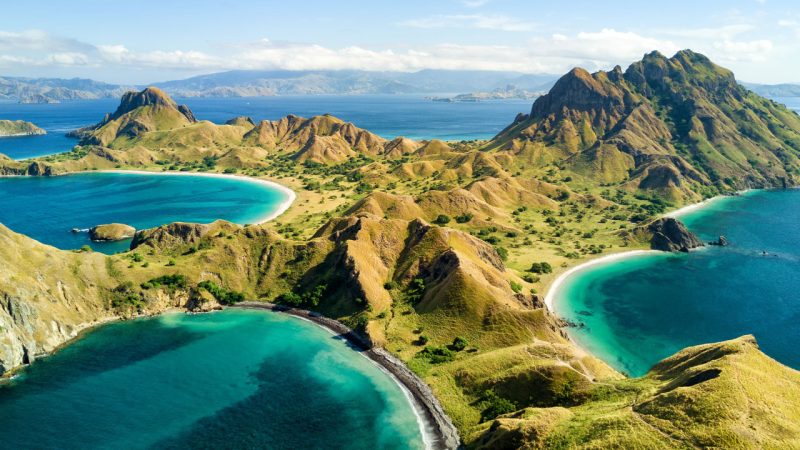
In the dry season, rain is less frequent and less prolonged, seas are generally calmer, and boat schedules are more reliable. The hills across the park dry out and turn brown, the dry, brown landscape commonly seen in photographs of Komodo. Days are hot and exposed, particularly on the treks.
In the wet season, rain is more frequent, often as heavy afternoon showers rather than all-day drizzle. Seas are less predictable and open crossings can be uncomfortable. The hills turn green, which many visitors find more striking, and there are far fewer people.
Neither season stops the park from operating. What changes is comfort, reliability, and what you are likely to see.
Month by Month
January to March
The wettest and least settled stretch of the year, and the quietest.
Rain is frequent, seas can be rough, and crossings to more exposed parts of the park are more weather-dependent. In exchange, visitor numbers are at their lowest, and the landscape is at its greenest.
Dive operators consistently associate this period with stronger manta ray activity, though they disagree considerably on the exact window. See the wildlife section below.
If your dates are already set: build flexibility into your itinerary rather than a fixed schedule, and expect at least one plan to change. This is a good period for a longer trip and a poor one for a tightly packed two-day dash.
April to June
For most visitors, the strongest overall window.
Rain typically eases, seas settle, and the landscape is still green from the wet season before drying out. Visitor numbers are below peak. In 2026, BMKG identified April as the start of the dry season for Nusa Tenggara Timur, earlier than the long-term average.
If your dates are already set, you have likely picked well. The main variable is how far into the transition your specific dates fall, which the current BMKG forecast will tell you.
July to September
Peak season, and the most settled conditions of the year. BMKG forecasts August 2026 as the peak of the dry season.
This is also the busiest period, and the point at which the park’s daily visitor limit is most likely to bite. The landscape is fully dry and brown, and the treks are hot and exposed.
If your dates are already set: book park entry and boat trips well in advance, and start early in the day for the walks.
October to December
A shoulder period that shifts across its length. Early on, conditions often resemble the tail of the dry season. By December, the wet season is usually established, and BMKG forecasts the 2025/2026 rainy season to begin in November.
Crowds thin out after the peak.
If your dates are already set: November and December are less predictable than October, so allow more room in the schedule the later in the period you travel.
Sea Conditions and Boat Travel
Almost everything in Komodo National Park is reached by boat, so sea conditions matter more here than weather on land.
The general pattern is straightforward. Seas are calmer and more predictable during the dry season, and less so during the wet, when winds and swell are more variable. Crossings to more exposed parts of the park are the first thing affected.
Two things are worth saying plainly. Conditions vary by day and by location, not just by season, so a rough week in June and a calm week in February are both possible. And decisions about where a boat goes on a given day are made by operators based on the conditions in front of them, not by a calendar.
If you are prone to seasickness, the wet season is harder, and an overnight trip amplifies whatever the sea is doing. Discuss it with your operator when booking rather than on the morning of departure.
Trekking and Conditions on Land
The walks in the park are short but exposed, with very little shade. Heat is the main consideration for most of the year.
In the dry season, trails are firm, and the heat is the limiting factor. Early starts make a substantial difference, both for comfort and for light. In the wet season, trails can be slippery, and rain may arrive with little warning, but the air is cooler and the landscape green.
The seasonal change in the landscape is more dramatic than most visitors expect. The famous view from Padar is a different photograph in May than in September, and the dry, brown landscape commonly seen in photographs of Komodo is the later one. If a green landscape matters to you, that points toward the earlier part of the year.
Crowds and the Visitor Quota
Komodo has become considerably busier. BTNK, the park authority, recorded 429,509 visitors in 2025, around 68 per cent of them foreign.
In response, BTNK officials have reported a daily visitor limit of 1,000 people, with the policy reported to be in effect since 1 April 2026. This can matter most during peak travel periods, when demand is highest.
This changes how season affects planning. Peak months were always busier; now they can also be capacity-constrained. In April 2026, during low season, a group of visitors was reported to have been turned away from the Padar summit because the daily quota was already full.
The practical consequence is the same whichever month you choose: book park entry in advance rather than assuming availability. Our guide to park fees and permits covers how reservations work and where to check current availability.
Wildlife and What People Hope to See
Komodo dragons are present year-round, and seeing them is not a seasonal question in the way that marine life is.
Manta rays are where the timing question gets complicated, and where published information is least reliable.
Mantas are present in the park throughout the year. Dive operators broadly agree that the wetter months bring larger aggregations, which is generally attributed to plankton in the water. Beyond that, the sources diverge sharply. Published operator guides variously give the manta window as January to March, October to March, November to April, December to April, November to June, and November to February.
These cannot all be right. Every one of those sources is a business selling dive trips, and no authoritative confirmation of a specific season was found.
The useful approach is therefore not to pick a date range from a website. Ask the operator you are considering what they have actually encountered in the month you are looking at, and how recently. A specific answer about recent sightings is worth more than any published window.
Choosing by Trip Type
| Your priority | Suggested period |
|---|---|
| Most settled weather and reliable schedules | July to September |
| A green landscape and photographs that differ from the usual | January to May |
| Fewer people | January to March, or late in the year |
| Best overall balance | April to June, or October to November |
| Marine life over comfort | The wetter months, with flexibility built in |
| Fixed dates already booked | Read the relevant period above and plan around its constraints |
What to Check Before You Book
- The current BMKG seasonal forecast for your travel year. The dry season forecast is published each March and the rainy season forecast each September, at bmkg.go.id
- Short-range forecasts for Manggarai Barat closer to departure
- Park entry availability for your dates, given the daily limit
- What your operator has actually seen recently, particularly for marine life
- How much flexibility your itinerary allows, which matters more the wetter the period
The seasonal patterns described here reflect BMKG information available as of 31 August 2026. Anything specific to your travel year should be checked against the current forecast. For the wider planning picture, see our Travel Planning section.
Frequently Asked Questions
It depends on your priorities. April to June and October to November offer the best balance of conditions and crowds. July to September has the most settled weather and the most visitors. January to March is the wettest and quietest.
The general pattern is a dry season across the middle of the year and a wet season around the turn of the year. The exact timing shifts, and BMKG publishes updated forecasts each March and September.
Yes. BMKG has described rain during the dry season as a normal occurrence, caused by passing tropical atmospheric waves, and light rain remained possible in the region even at the forecast peak of the 2026 dry season.
January and February are typically among the wettest months, with less predictable sea conditions and fewer visitors. However, they may appeal to travelers who prioritize greener landscapes or marine life and can accept greater weather variability.
Operators disagree. Published windows range from January to March through to November to June, and every one of those sources sells dive trips. Mantas are present year-round. Ask your operator about recent sightings rather than relying on a published season.
It is the busiest period. BTNK recorded more than 429,000 visitors in 2025, and officials have reported a daily visitor limit in effect since April 2026, so booking ahead matters most then.
Yes. Expect more rain, less predictable seas, and a greener landscape, with fewer people. Build flexibility into the itinerary.
The hills are green after the rains and brown through the dry season. The dry, brown landscape commonly seen in photographs of Komodo is the latter.
Leave a reply