
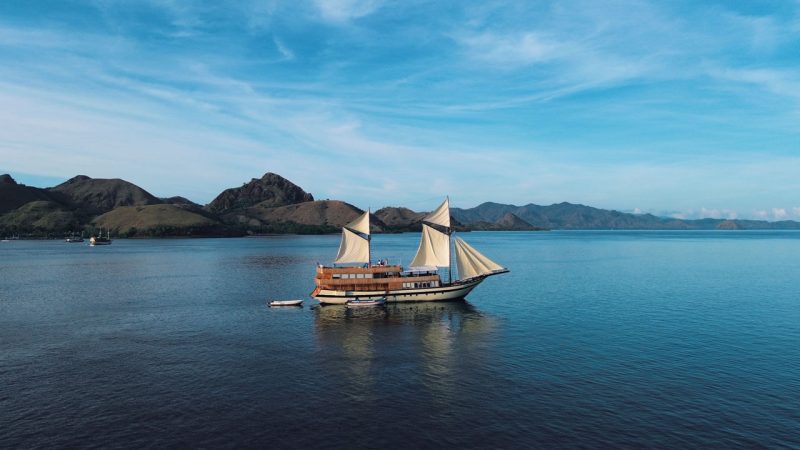
What to expect on a Komodo boat trip depends less on the itinerary than on the boat. Two departures from Labuan Bajo on the same day, covering the same sights, can feel very different once you are aboard. This guide covers the parts of the experience that are set by the authorities, the parts that vary from vessel to vessel, how to approach seasickness, and the questions worth asking so that you know what to expect before you board.
KomodoYacht.com is an independent information site. We do not sell trips, take bookings, or work with operators, so nothing here describes a particular boat. This guide is part of our Boat Trips section.
Why no two boat trips are quite the same
The experience aboard follows the vessel and the operator more than the route. Size, layout, equipment, and the way the crew run the day all differ from one boat to the next.
Most published descriptions of life aboard are written by companies selling trips, and they do not agree with one another about what a typical boat offers. Rather than repeat claims that hold for some boats and not others, this page separates three things: what is regulated, what varies, and what you can ask.
Two related questions are covered elsewhere: what the class labels mean, and whether you will have a shared or private cabin.
Before you leave the harbour
Some of what happens at departure is set by the harbour authority rather than the operator. According to a detikBali report on implementation guidance dated 14 October 2024, KSOP Labuan Bajo, the local harbourmaster and port authority, required tourist boats, including pinisi and other wooden vessels, to:
- give a safety demonstration before sailing
- carry a number of passengers that matches the passenger list, or manifest, and stays within the boat’s approved capacity
- monitor the weather before departure
For a passenger, this means two practical things. Because passengers are meant to be listed on a manifest, expect the operator to need your details before departure. And there should be a safety briefing before the boat leaves; if none is given, it is reasonable to ask for one.
These are requirements placed on the vessel, not a guarantee of how any particular boat meets them. What you can sensibly look into about the vessel is covered in our guide to checking the boat itself.
Nights aboard
On an overnight trip, where the boat spends the night is partly a matter for the authorities.
In January 2026, KSOP Labuan Bajo announced restrictions on night-time vessel movements in Komodo National Park waters, particularly at higher-risk locations such as Selat Padar, according to Indonesia’s state news agency, ANTARA. Boats were instructed to shelter and remain in place after dark. The restrictions were introduced after a fatal incident in late December 2025. Subsequent sailing notices issued during weather warnings in 2026 also repeated night-sailing restrictions.
This guide could not confirm whether a standing, year-round restriction applies outside those warning periods, or exactly which waters it covers. Arrangements depend on the harbour authority’s instructions at the time, so it is worth asking your operator where the boat will spend the night.
Where you sleep once aboard is a separate matter, and it varies by vessel; the questions later on this page cover it. If you are still deciding whether to stay overnight, our liveaboard and day-trip comparison weighs the case for sleeping aboard at all.
Conduct aboard inside the national park
Two rules in Komodo National Park’s visitor protocol are directly relevant to passengers on a boat. The protocol prohibits leaving litter of any kind in the park and making loud noise, including loud music and karaoke (Balai Taman Nasional Komodo, visitor protocol, page last updated 7 January 2026). It also asks tour operators and guides to make sure their guests follow these rules.
When the weather changes the plan
Weather can change a trip after it has started, and the decision is not always the operator’s. KSOP Labuan Bajo issues sailing notices, known as maklumat pelayaran, based on maritime forecasts from Indonesia’s meteorological agency, BMKG. These notices can restrict or suspend tourist sailing at short notice.
One example: CNN Indonesia reported that KSOP’s Sailing Notice No. 05/MP-V/2026, dated 23 May 2026, suspended tourism activity by tourist and commercial vessels in the southern waters and the southern part of the Sape Strait for a four-day warning period. According to the same report, the notice was based on a BMKG forecast of waves between 1.5 and 2.1 metres, and it also banned night sailing and required safety briefings before departure.
In practice, a planned route or stop can change mid-trip. Our guide to the best time to visit explains how sea conditions vary through the year. What to clarify about weather and cancellation terms before you pay is a separate question.
Seasickness
Why it happens
Motion sickness happens when the movement your inner ear senses does not match what your eyes see. Ireland’s Health Service Executive (HSE) lists symptoms including dizziness, nausea, vomiting, headache, paleness and sweating. Northern Ireland’s official information site, nidirect, whose guidance is adapted from NHS content, notes that children and pregnant women are more prone to it.
What can help
Both services give similar general advice:
- find a spot with less movement, such as the middle of the boat
- look at a steady point in the distance, or at the horizon
- get fresh air
- avoid reading and screens
- avoid heavy or spicy meals, and alcohol
- try ginger, as a tablet, biscuit or tea
Sea conditions around Komodo change with the season and with the weather on the day, so how a particular crossing will feel cannot be known in advance.
Remedies and who to ask
Pharmacies sell remedies for motion sickness as tablets, including dissolvable versions for children, and as patches. The HSE describes patches as suitable for adults and children over 10. Acupressure bands are also sold, though both services note they do not work for everyone.
Which remedy, if any, suits you is a question for a pharmacist or doctor, particularly for a child or during pregnancy.
What varies from boat to boat, and what to ask
The arrangements below differ from one vessel to the next, and published descriptions do not agree on what is typical. A clear answer before you board is more useful than an assumption.
- Sleeping. Where exactly will I sleep, and is sleeping on deck possible or permitted? Knowing where you will spend the night avoids surprises once the boat has left harbour.
- Water and showers. Is the shower fresh water, and is water limited at any point during the trip? How water for washing is supplied affects your routine on a trip of more than a day.
- Cooling. Is there air conditioning or a fan, and does it run through the night? How a sleeping area is ventilated or cooled can affect how well you rest.
- Power and noise. When is power available for charging devices? How close is my sleeping area to the engine or generator? This matters if you rely on a phone or camera, or if you sleep lightly.
- Meals. Can dietary requirements be met if I tell you in advance? Raising allergies or other requirements before departure gives the operator a chance to plan.
- Luggage. How much space is there for bags? Bag space is worth clarifying before you arrive at the harbour.
- Shade. Is there shaded deck space during the day? Shade on deck affects comfort when the boat is between stops.
- Getting ashore. How are passengers taken ashore at each stop? This matters if you have limited mobility or are carrying equipment you want to keep dry.
- Language. Which languages do the crew and guide speak? Briefings and instructions are only useful if you can follow them.
An operator who can answer these readily is easier to plan with. These questions are about the days on board. Questions about the vessel itself, and about payment and terms, are covered in the guides linked above.
Frequently asked questions
According to reports by detikBali and CNN Indonesia, harbour authority guidance issued in October 2024 requires tourist boats to give a safety demonstration before sailing, and a weather-warning notice in May 2026 also required pre-departure briefings. If none is given, ask for one.
In January 2026, the harbour authority announced restrictions on night-time movements in park waters, particularly at higher-risk locations, and weather-warning notices in 2026 repeated them. Whether a standing restriction applies at other times, and where, could not be confirmed. Ask your operator where the boat will spend the night.
National health services suggest staying in the middle of the boat, watching the horizon, getting fresh air, and avoiding screens, heavy meals, and alcohol. A pharmacist or doctor can advise on remedies.
The park’s visitor protocol prohibits loud noise, including loud music and karaoke.
Where you will sleep, how water, cooling, and power are arranged, whether dietary needs can be met, how passengers get ashore, and which languages the crew speak.
Leave a reply