
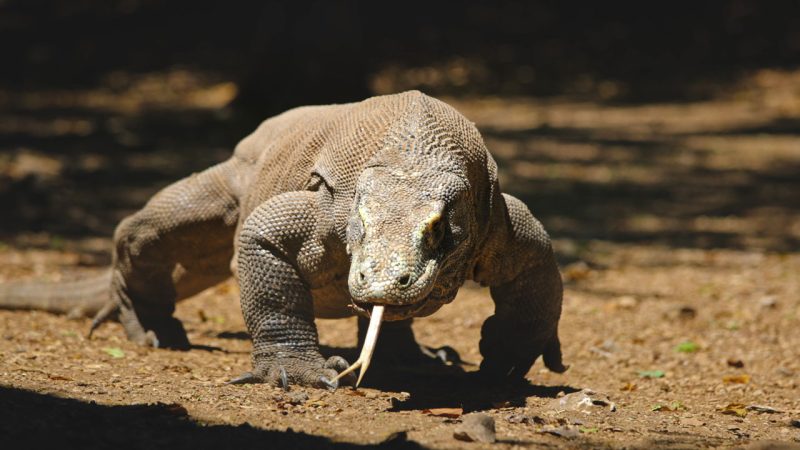
The Komodo dragon is the largest living lizard, a monitor found naturally on a handful of islands in eastern Indonesia and nowhere else. It is the animal that gave Komodo National Park its name, and it is listed as Endangered on the IUCN Red List.
This guide covers the animal itself. Where published sources disagree, the disagreement is set out rather than smoothed over.
What a Komodo dragon is
The Komodo dragon, Varanus komodoensis, is a monitor lizard of the family Varanidae. It is endemic to the Lesser Sunda Islands of Indonesia and is the largest lizard alive today.
Size, and the figures that get exaggerated
Size is where published figures drift furthest. The Smithsonian’s National Zoo gives the typical weight of a wild adult as about 70 kg, and the largest verified specimen as 3.13 m and 166 kg. The record is not the norm.
Senses
Smell is the dragon’s main way of finding food. It flicks a forked tongue to gather scent particles from the air and passes them to the Jacobson’s organ in the roof of its mouth. The Smithsonian reports that dragons can detect carrion up to 4 km away.
Where Komodo dragons live
The islands
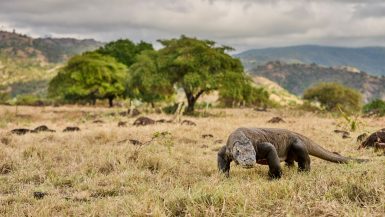
Inside the national park, Komodo dragons live on Komodo, Rinca, Padar, Gili Motang and Nusa Kode. Outside it, they live in northern and western Flores. Their habitat runs from beaches to ridge tops through savanna and dry forest.
Padar is a case where sources disagree. The Smithsonian’s National Zoo states that dragons have not been seen there since the 1970s. More recent Indonesian government information differs. In September 2025, the Ministry of Forestry described monitoring on Padar as showing a population that had been stable for three years. A public consultation that year also made recommendations about protecting dragon nests on the island.
Our guide to where dragons can be observed covers the places visitors go separately.
How they hunt and what they eat
Komodo dragons eat almost any meat, killing live prey and scavenging carcasses. Adults are ambush hunters. They wait beside game trails, sometimes for hours, and depend on a short burst of speed and a single bite. According to the Smithsonian’s National Zoo, most attempts fail.
Adults take deer, wild pigs, and water buffalo. Young dragons eat insects, small lizards, snakes, and birds, moving on to larger prey such as deer at around five years old.
Carcasses are often shared between several dragons. The Smithsonian reports that an adult can eat up to 80 per cent of its own body weight in a single meal.
The bite: venom, bacteria, and what the research actually found
For decades, the standard explanation was bacterial. Prey that escaped a bite were said to die later from infection caused by bacteria in the dragon’s mouth. That account is still widely repeated: the Smithsonian’s National Zoo describes bacteria and venom in the saliva acting together, and refers to about 50 bacterial strains, at least seven of them highly septic.
In 2009, Bryan Fry and colleagues reported in the Proceedings of the National Academy of Sciences that the dragon has venom glands, which they described as the most complex then known in any reptile. Tests showed effects including a sharp fall in blood pressure and prolonged bleeding. The authors rejected septicaemia as the main cause of prey death. They attributed death instead to venom combined with deep wounds from the dragon’s serrated teeth; the bite itself is relatively weak.
In 2013, Goldstein and colleagues, writing in the Journal of Zoo and Wildlife Medicine, cultured bacteria from the mouths of 16 captive dragons at three US zoos. They found no virulent species. They concluded that the bacteria largely reflected the animals’ recent meals and surroundings, and were unlikely to cause rapid fatal infection.
Two limits matter. First, the 2013 study examined captive animals, whose diet and environment differ from those of wild dragons, so it does not describe wild populations. Second, none of this means a bite is harmless: a deep bite from a large predatory reptile is a serious wound. What has changed is the explanation of how prey die, and on present evidence venom is central to it.
Behaviour and life stages
Heat, shade and burrows
Komodo dragons are largely solitary, although several may gather at a large carcass. Like other reptiles, they rely on outside sources of heat to regulate their body temperature. According to the Smithsonian’s National Zoo, they avoid the heat of the day and shelter at night in burrows often only just large enough for them.
Growing up
Hatchlings weigh less than 100 g and measure about 40 cm. Young dragons spend their early years in trees, which the San Diego Zoo Wildlife Alliance says reduces their risk of predation. They come down to live on the ground at around four years old, when they are about 1.2 m long.
Adults will eat younger dragons, which is one reason the young stay in the trees.
Reproduction and the life cycle
Nests and eggs
The Smithsonian’s National Zoo gives the mating period as May to August. A study on Komodo Island led by Tim Jessop, covering the 2002–2003 season, found that breeding females used mound nests for 61 per cent of nests. Open hillside nests and ground nests made up the rest in equal shares. The Smithsonian identifies these mounds as megapode nests, built by ground-dwelling birds.
The San Diego Zoo Wildlife Alliance gives clutch size as 20 to 30 eggs, while the Smithsonian gives about 30. Incubation is long: the Smithsonian gives about nine months. The San Diego Zoo Wildlife Alliance’s species fact sheet gives a range of 2.5 to 8 months, which it links to temperature and soil moisture, and separately about 220 days for eggs incubated in managed care. Both sources say the female may protect the nest.
Published lifespan figures differ. The Smithsonian and the San Diego Zoo give about 30 years, or up to 30, in the wild, and the Smithsonian adds that scientists are still studying this. A 2026 Ministry of Forestry (In-Flores) publication reports that Komodo dragons can live for more than 40 years. Lifespans in the wild and in human care should not be treated as interchangeable.
Reproduction without a male
In 2006, Phillip Watts and colleagues reported in Nature that females at Chester Zoo and London Zoo had produced young without mating, a process called parthenogenesis.
Genetic testing showed that the offspring were not clones: one set of the mother’s chromosomes had been duplicated. Females carry ZW sex chromosomes, and males carry ZZ; WW embryos are not viable, so every young dragon produced this way is male.
The researchers suggested it may occur in the wild where a female is isolated without males, and noted that it reduces genetic diversity.
Their place in the island ecosystem
The Komodo dragon is the largest land predator where it lives, and it depends on large prey. Where deer and other prey are hunted or lose their habitat, dragons decline too.
Each island population is also largely on its own. A 2014 study by Purwandana and colleagues in Biological Conservation concluded that movement between islands is probably infrequent, and recommended managing each island separately.
How many Komodo dragons are left
Why the published figures differ
The two most-quoted population figures are not directly comparable, which is why so much published material about this species is confused.
The IUCN Red List assessment estimates fewer than 1,400 mature individuals (the Red List record gives 1,383) across the species’ whole range, in eight subpopulations, none larger than 500. IUCN’s World Heritage Outlook assessment of Komodo National Park, finalised in October 2025, reports the same basis.
The annual estimates from the national park authority, Balai Taman Nasional Komodo (BTNK), cover Komodo National Park only. The populations on Flores lie outside the park. The Ministry of Forestry’s official Conservation Strategy and Action Plan for the species says the 2018–2024 estimates were calculated from camera-trap monitoring and site-occupancy analysis. None of the sources consulted states which age classes the BTNK series represents.
One figure counts mature individuals across the whole range; the other covers the park only, with its age classes unstated. They cannot be set side by side as competing estimates, and they are not combined here.
What the monitoring shows
BTNK’s annual figures for the park, reported by Indonesia’s state news agency ANTARA in March 2025, were:
- 2,897 in 2018
- 3,022 in 2019
- 3,163 in 2020
- 3,303 in 2021
- 3,156 in 2022
- 3,396 in 2023
- 3,270 in 2024
The estimates fluctuate. The head of BTNK described the 2024 trend as within a stable range, and in 2025 UNESCO’s World Heritage Committee welcomed a stable population. The Ministry’s conservation strategy describes the trend over the seven years as positive despite the annual fluctuations. The series does not show uninterrupted annual growth.
An In-Flores publication dated 26 February 2026 quotes the Ministry of Forestry’s Director of Species and Genetic Conservation as giving 3,270 ± 371 individuals inside Komodo National Park and about 701 ± 131 on Flores outside it, plus 177 individuals in ex-situ conservation facilities. The date is the publication’s, not that of a new count. The Ministry’s conservation strategy identifies 3,270 ± 371 as the park’s latest estimate for 2024 and gives 177 ex-situ animals as of 2024. It gives no year for the Flores figure. The ex-situ animals are not part of the wild totals.
An earlier peer-reviewed estimate (Purwandana and colleagues, 2014; data from 2003 to 2012) put the total for four park islands at about 2,448, including about 1,166 on Komodo Island and 1,185 on Rinca. Padar was not included.
Why the species is listed as Endangered
The IUCN Red List record lists the Komodo dragon as Endangered under criterion C1. The assessment was carried out on 5 August 2019 and published in 2021, and the Ministry of Forestry referred to the Endangered listing in February 2026. IUCN’s 2025 World Heritage Outlook rates the overall conservation outlook for Komodo National Park as of “significant concern”.
Climate change and sea level
A 2020 study in Ecology and Evolution by Jones and colleagues modelled the effects of warming and sea-level rise. It projected that habitat across the species’ range could shrink by between 8 and 87 per cent by 2050, and identified Komodo and Rinca as the islands with the lowest risk of local extinction.
These are projections, not certain outcomes.
Prey, habitat and human pressure
Prey poaching, habitat loss, invasive predators and small, isolated populations all weigh on the species. Deni Purwandana of the Komodo Survival Program said in February 2026 that about half of the dragon’s distribution on Flores lies outside formal conservation areas.
IUCN’s 2025 assessment rates fire as a low threat.
Tourism development and World Heritage oversight
In 2025, UNESCO’s World Heritage Committee (decision 47 COM 7B.6) welcomed a strategic environmental assessment for the park. It noted, however, that the assessment identifies potential impacts on the property’s Outstanding Universal Value from proposed tourism infrastructure, including five business licences already issued. It restated its concern about a 2020 decree exempting park tourism infrastructure from environmental impact assessment.
In September 2025, the Ministry of Forestry set out its position on a proposed resort on Padar. It said foundation work had stopped in June 2022 pending environmental assessment, and that a public consultation was held in July 2025. The consultation’s recommendations included limiting the built area, raising roads to avoid felling trees, and keeping a 10-metre radius around dragon nests free of construction. The Ministry said the developer must take these recommendations into account.
For small, separate populations, where buildings go and whether nests are protected both matter. The project’s status after September 2025 could not be confirmed for this guide. Indonesia’s next report to UNESCO is due by 1 December 2026.
Protection and monitoring
Komodo National Park was established in 1980 and became a World Heritage Site in 1991. BTNK monitors the population annually with the Komodo Survival Program, and a national conservation strategy for the species runs to 2035.
IUCN rates the park’s protection and management as of “some concern”, and its management of tourism as of “serious concern”.
Are Komodo dragons dangerous to people?
A Komodo dragon is a large wild predator capable of seriously injuring a person. The venom research does not make a bite less serious.
Frequently asked questions
Yes. Research published in 2009 described venom glands and venom that lowers blood pressure and prolongs bleeding. This challenged the older view that prey die mainly from bacteria in the dragon’s mouth.
It depends on what is being counted. The IUCN estimates fewer than 1,400 mature individuals across the whole range. Park counts for Komodo National Park alone have ranged from about 2,900 to 3,400 since 2018.
Their small range is split into isolated subpopulations, none of which holds more than 500 mature individuals. They also face climate change, sea-level rise, loss of prey and habitat, and development pressure.
A typical wild adult weighs about 70 kg. The largest verified specimen measured 3.13 m and weighed 166 kg.
Almost any meat. Adults take deer, wild pigs, and water buffalo; young dragons eat insects, small lizards, snakes, and birds. They also eat carrion.
Yes. Captive females have produced young through parthenogenesis, and all offspring produced this way are male.
Sources differ. The Smithsonian and San Diego Zoo give about 30 years in the wild, while a 2026 Ministry of Forestry publication reports that they can live for more than 40 years. The question is still being studied.
On Komodo, Rinca, Padar, Gili Motang, and Nusa Kode in the national park, and in northern and western Flores.

Leave a reply