
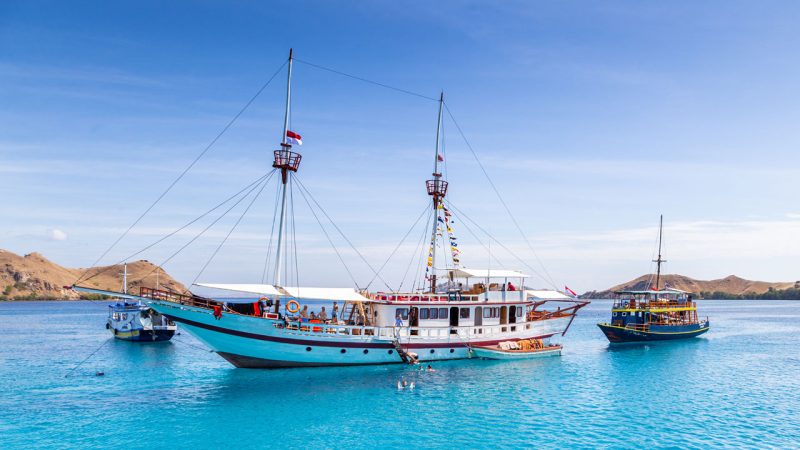
Anyone comparing boat trips in Komodo runs into the same wall. One operator offers a Superior boat, another a Deluxe, a third a Standard phinisi, and a fourth a semi-phinisi. The words look like a scale. Comparing quotes should be simple.
It is not, and the reason is worth understanding before you spend money on the assumption that it is.
KomodoYacht.com sells nothing, takes no commission, and has no relationship with any operator. What follows explains what these terms mean, what they do not tell you, and what to ask instead. For the wider picture on how boat travel in the park works, see our Boat Trips section.
Why the labels are confusing
The labels are not standardised, and different operators use the same word to mean different things.
This is not a matter of loose definitions around the edges. Reviewing how operators in the Labuan Bajo market present their fleets, the same term appears at opposite ends of different scales.
In one operator’s system, Superior is the entry-level tier, with Deluxe above it and Luxury at the top. In another, Superior sits third of four, above a Standard tier. In a third, it appears as the second rung on a price ladder that starts with Regular boats.
The structures differ too, not just the definitions. One classification runs Standard, Semi-Phinisi, Luxury Phinisi. Another runs Phinisi Luxury, Phinisi, Semi-Phinisi, which uses the name of a vessel type as a middle service grade. A fourth applies the same ladder to speedboats, offering Standard, VIP and VVIP versions.
The clearest illustration of the problem appears within a single operator’s own description of one boat, which is placed in the Superior category and referred to two sentences later as a standard type.
None of this is dishonest. There is simply no shared system, so each operator builds its own. The consequence for a traveller is the same either way: two boats described with the same word may have very little in common.
The vessel: what kind of boat it is
Underneath the marketing tiers, there is a real distinction, which is what kind of boat you are actually on.
Pinisi
The traditional Indonesian sailing vessel most Komodo trips are marketed around is properly spelled pinisi. That is the spelling used by Indonesia’s Directorate General of Culture and by the Indonesian delegation to UNESCO. In December 2017, at the 12th session of the UNESCO Intangible Cultural Heritage Committee in Jeju, South Korea, “Pinisi: Art of Boatbuilding in South Sulawesi” was inscribed on the Representative List of the Intangible Cultural Heritage of Humanity.
The Komodo tourism market almost universally writes it as phinisi, and you will see that spelling on nearly every operator’s site.
The vessel comes from the Bugis, Makassar and Konjo communities of South Sulawesi, and boatbuilding continues at centres including Tana Beru, Bira and Batu Licin in Bulukumba regency. Indonesian cultural sources note that hull-building knowledge of this kind has been practised for at least 1,500 years.
One detail is worth knowing, because it explains a great deal about how loosely the word now travels. Pinisi originally described the rig, the arrangement of masts and sails, rather than the shape of the hull. The term was never a description of accommodation, size, or comfort.
Today it is used commercially for a wide range of vessels. Boats marketed as phinisi differ substantially in construction, age, layout and finish. The word tells you roughly what the boat looks like. It does not tell you what is aboard it.
Semi-phinisi and regular boats
Semi-phinisi is a market term rather than a formal category. It generally indicates a vessel resembling the traditional form but smaller or simpler. There is no definition it must meet.
Regular or wooden boats are described by operators as vessels without the distinctive phinisi profile. Notably, at least one operator states that regular boats can carry facilities comparable to a phinisi, differing mainly in appearance and interior. That is an operator’s account rather than an independent finding, but it points to something useful: the silhouette and the facilities are separate questions.
Speedboats
A speedboat is a different kind of vessel doing a different job: covering distance quickly, usually for day trips rather than overnight travel.
It is not a quality tier. A speedboat is not automatically more comfortable, more premium, or better equipped than a wooden boat, and the market bears this out, since operators sell speedboats across their own Standard, VIP, and VVIP grades in exactly the way they grade everything else.
The service label: standard, superior, deluxe, luxury
The second set of terms describes what an operator says is provided aboard: cabins, facilities, finish, and level of service.
These are the words with no shared meaning. Standard, Superior, Deluxe, Luxury, VIP and VVIP are each defined by the operator using them, and the ladders they sit on vary in both order and number of rungs.
There is no industry body assigning these grades, no criteria a boat must meet to be called Deluxe, and no reason to expect one operator’s Superior to resemble another’s.
Why the two get mixed up
The two sets of terms belong to different systems, and the market routinely combines them.
“Luxury Phinisi” uses one word from each: a vessel type and a service grade. That combination is at least legible. The problem arises when a vessel name is used as a grade in its own right, as in a ladder running Phinisi Luxury, Phinisi, Semi-Phinisi. Here “Phinisi” is not describing what the boat is but where it sits on a scale of expense.
Once a vessel type has become a tier, the two axes have collapsed, and a reader has no way to tell whether a term is describing the boat or the service. That collapse is the single biggest reason this market is hard to compare.
Keeping them separate helps: ask what kind of boat it is, and separately ask what is provided aboard it. They are different questions with different answers.
Speedboat or slower boat: a different question
Speed sits outside both axes, and it matters mainly for day trips.
A faster boat spends less of the available hours travelling between Labuan Bajo and the park, and more of them at the places you came to see. Within a fixed day, that shifts the balance considerably.
This is a question about how your time is spent rather than about quality, and it belongs to the choice between a day trip or an overnight liveaboard, where it is covered properly.
What a label can tell you
The terms are not useless. Within a single operator’s range, they are meaningful.
If one operator offers Standard, Superior, and Deluxe boats, that ladder tells you something real about how that operator ranks its own fleet, and probably about relative price. Comparing within one operator’s list is reasonable.
A vessel-type word also gives you a rough visual expectation. If a boat is described as a phinisi, it will most likely have the traditional two-masted wooden profile.
What a label cannot tell you
Across operators, the terms carry almost no comparable information. A label on its own does not reliably tell you the size of the boat, how many people it carries, whether cabins are private or shared, what facilities are aboard, what condition or age the vessel is in, or what the price ought to be.
It also carries no official meaning. Indonesia does regulate vessels carrying passengers through the Ministry of Transport and the port authority in Labuan Bajo, covering seaworthiness, legal status, and crewing. That framework is entirely separate from the marketing tiers, and it does not grade boats as Standard, Superior or Deluxe. No official classification corresponding to those words was found.
Labels also cannot tell you what a trip will actually feel like. What the days aboard involve is a separate subject from what the boat is called.
What to check instead
If the labels cannot be compared, something else has to be. These questions can all be answered by any operator, and the answers are comparable across all of them.
- The boat’s name. A specific vessel, not a category. This single question changes the conversation, because it lets you look at a boat rather than a tier.
- Photographs of that specific boat, not a fleet gallery or a stock image of a similar vessel.
- Photographs of the specific cabin you would be booking, where the trip involves nights aboard.
- Whether the bathroom is inside the cabin or shared. This differs widely and is rarely clear from a label.
- What is included in the price, itemised.
- How long the journey takes from Labuan Bajo, which matters most on day trips.
- How many other passengers will be aboard, if the trip is shared.
An operator who answers all of these clearly is telling you more than any tier name does. One who cannot, or will only describe the category, has told you something as well.
How this affects your choice
Three practical consequences follow.
Compare boats, not tiers. Two quotes using different vocabulary can only be compared through the specifics underneath. Ask both operators the same questions from the list above and compare the answers.
Do not read a price difference as a quality difference across operators. Because the ladders are not aligned, a more expensive Superior boat and a cheaper Deluxe boat tell you nothing reliable about which is better.
Treat vessel type and service level as separate. Whether a boat is a phinisi is a question about the boat. What is aboard it is a different question, and the answer is not implied by the first.
Whether you share the boat with other travellers is a third question again, covered in our comparison of an open trip or private charter. All three combine, which is part of why the market is so hard to read at a glance.
For a specific vessel, the next step is to check what you can verify before booking; see our guide to how to assess a Komodo boat before you board.
Frequently asked questions
A traditional Indonesian sailing vessel from South Sulawesi, properly spelled pinisi, though the tourism market almost always writes phinisi. The term originally described the sail arrangement rather than the hull. Boats sold as phinisi vary considerably in construction, age, layout and what is provided aboard.
There is no consistent answer, because the terms are not standardised. Different operators place the same word at different points on their own scales, and one operator’s Superior may be another’s entry level. Compare the specific boat rather than the label.
They are different things rather than different grades. A speedboat is built for covering distance quickly, usually on day trips; a phinisi is a vessel type used for both day and overnight trips. Neither is automatically better equipped or more comfortable.
The boat’s name, photographs of that specific vessel and cabin, whether the bathroom is inside the cabin, what is included, how long the journey takes, and how many passengers will be aboard. Those answers are comparable between operators. Tier names are not.

Leave a reply