
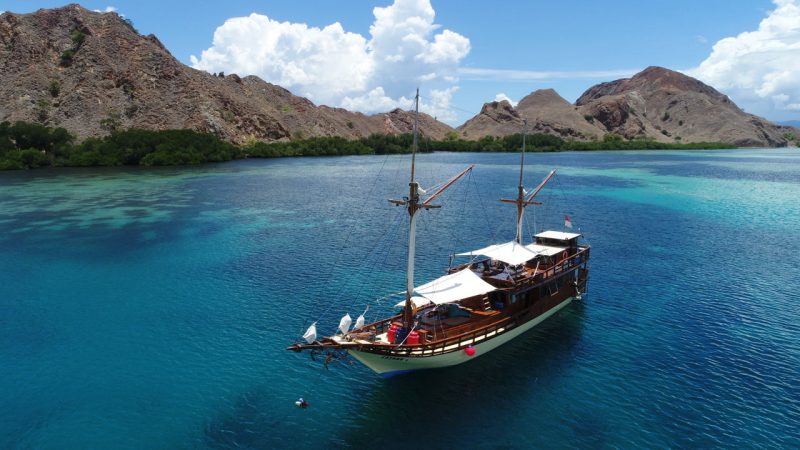
Anyone researching a Komodo boat trip meets the word within about five minutes. Operators advertise phinisi trips, phinisi charters and phinisi cabins, usually without explaining what a phinisi is.
It refers to a boatbuilding tradition from South Sulawesi, several hundred kilometres from Komodo, and originally described something narrower than the boats it is now attached to. This page covers where the tradition comes from, how these vessels are built, what UNESCO actually recognised, and what the name does and does not tell you about a boat you are considering.
For the wider picture on boat travel in the park, see our Boat Trips section.
What a pinisi is
There are two things the word can mean, and separating them makes everything else clearer.
The broader subject is a boatbuilding and sailing tradition of the Bugis, Makassar and Konjo communities of South Sulawesi, which is what UNESCO recognised as the art of boatbuilding. Vessels built in that tradition historically carried cargo between islands.
Pinisi in its narrower and original sense refers to something more specific within that tradition: a particular arrangement of masts and sails.
The rig the name refers to
Indonesia’s Directorate General of Culture puts it plainly: literally, pinisi is the term for the rigging, masts and sails of a Sulawesi schooner. The same source notes that among Indonesians, and internationally, the word has since become a popular label for most types of Nusantara boat.
The traditional configuration is commonly described as two main masts and seven sails — three at the bow, two forward and two aft.
The number seven attracts traditional interpretations. One holds that the seven sails represent Indonesian ancestors’ ability to cross the world’s seven great oceans; another connects the two masts and seven sails to Islamic devotional formulas. These are cultural readings rather than technical explanations, and more than one is current.
Pinisi or phinisi?
Both spellings are in use, and neither is an error in its own context.
Pinisi is the form used by Indonesian cultural authorities and in the UNESCO inscription. Phinisi is close to universal in the tourism market, including in the way trips to Komodo are advertised.
This page uses pinisi when discussing the tradition and phinisi where the tourism usage is the subject.
Where the tradition comes from
The boatbuilding centres most associated with pinisi are in Bulukumba regency on the southern tip of South Sulawesi, particularly around Tana Beru, Ara and Lemo-lemo. Indonesian cultural sources note that the same boatbuilding art is practised in other locations, including Batu Licin in South Kalimantan and several districts in South Sulawesi, generally by craftsmen originating from Bulukumba.
The knowledge itself is old. Indonesian cultural sources describe the boatbuilding tradition’s hull-assembly method and its underlying formula as having been known for around 1,500 years. That refers to the body of craft knowledge, not to any vessel afloat today.
There is also an origin narrative, and it should be read as what it is. A story recorded in the Bugis epic La Galigo tells of Sawerigading, crown prince of the Luwu kingdom, whose vessel broke into three parts in a storm. The pieces washed ashore at Ara, Tana Beru and Lemo-lemo, and the people of those three villages rebuilt them into a boat. This is oral tradition rather than documented history, and it is told to explain why those three villages became the centres of the craft.
How a pinisi is built
The construction sequence is documented, and it differs from what most people expect of boatbuilding.
The shipyard
Traditional pinisi are built in a bantilang, a shipyard usually sited close to the shoreline with the bow of the vessel facing the sea. There is no dry dock and no covered hall. The boat takes shape in the open; on the beach it will eventually be launched from.
Choosing and preparing the timber
Work begins before any wood is cut, with the selection of an auspicious day to look for timber. In Bulukumba, this is commonly the fifth or seventh day of the current month. The numbers carry meanings in the local language: five for naparilimai dalle’na, fortune already in hand, and seven for natujuangngi dalle’na, always receiving fortune.
The timbers used include ironwood, bitti, kandole or punaga, and teak. Quality and age of the wood are treated as decisive.
Felling, drying, and cutting the timber is the slowest part of the process and can take months.
Assembly and launch
The keel is laid first, and the sequence that follows is the reverse of European practice: the hull planking goes on before the internal framing, rather than planks being fitted to a completed frame.
Transverse beams known as kalang are then fitted across the hull to strengthen the sides and form the base of the deck. Foundation blocks called bangkeng salara are set to carry the masts, with three pairs for the forward mast and one for the aft. Cultural documentation notes that this stage requires particular skill, since errors affect how the vessel handles.
The seams between planks are then caulked to make the hull watertight, the surface finished, and the masts and sails fitted last.
Launching is a communal event. The finished hull is hauled across the sand to the water, traditionally by large numbers of people pulling on ropes.
The rituals that accompany the work
Ritual is not decoration around the construction; it is scheduled into it.
Ceremonies mark the felling of the tree, the cutting of the keel, the warding off of misfortune, a rite performed on the hull, and the launch. Cultural documentation records that when the keel is cut, it is oriented to the northeast, that the forward keel timber is treated as male and the after timber as female, and that the cut must be made in a single continuous motion, which is why the work is given to someone strong enough to complete it without stopping.
An academic study of the practice in Bulukumba describes the ritual sequence as running from the selection of the timber through to the launch, and as inseparable from the craft rather than added to it.
What UNESCO recognised
In December 2017, UNESCO inscribed the pinisi tradition on the Representative List of the Intangible Cultural Heritage of Humanity, as the art of boatbuilding in South Sulawesi.
The distinction matters, because operator marketing often blurs it.
What was recognised is the knowledge, skill and practice of building these boats, held by the communities of South Sulawesi. UNESCO did not inscribe any vessel. It does not certify, inspect, or approve boats, and no boat carrying passengers in Komodo is a UNESCO-listed object.
Mentioning the heritage is entirely reasonable. It simply does not tell you anything about the particular boat you are being offered.
From cargo vessel to tourism boat
This is the part most worth understanding before booking.
The traditional pinisi was a working cargo carrier, moving goods between islands under sail. The vessels used in Komodo tourism today are something related but different: they are built in that tradition, and adapted substantially for carrying passengers.
The most obvious change is propulsion. Modern examples generally run under diesel engines, with sails now often secondary or largely ornamental. Layout is different too, since a boat designed around cabins and deck space for passengers is not a boat designed around cargo holds.
Construction practice has also moved. Some boats are still built in Bulukumba by traditional methods; others are built elsewhere in the style, or combine traditional hull construction with modern materials and fittings.
None of that is a decline. A vessel carrying passengers has different requirements from one carrying cargo, and the changes are sensible answers to those requirements. But it does mean a modern phinisi is a contemporary passenger boat in a traditional idiom rather than a preserved historical vessel.
What the name tells a traveller, and what it does not
What it tells you: roughly what the boat will look like. A vessel described as a phinisi will usually have the wooden hull and the two-masted profile the tradition is known for.
What it does not tell you is almost everything else.
It does not confirm where or how the boat was built, or whether traditional methods were used. It does not indicate the vessel’s age or condition. It says nothing about cabins, facilities, capacity, or the standard of finish. It is not an indication of safety, and it does not imply any particular price.
The word is also used loosely. As Indonesia’s own cultural authority observes, the term has broadened from a specific rig to a general label for many kinds of boat — which is precisely why it cannot carry the weight operators sometimes place on it.
Two other pages cover what the name leaves open. How the market uses labels such as phinisi, standard and deluxe, and why they are not comparable between operators, is covered in our guide to how boat labels are used. What can actually be established about a specific vessel before you board it is covered in our guide to assessing a boat.
Frequently asked questions
The word covers two things. Broadly, it refers to the South Sulawesi boatbuilding and sailing tradition of the Bugis, Makassar and Konjo communities, which UNESCO recognised as an art of boatbuilding and whose vessels historically carried cargo between islands. More narrowly and originally, pinisi names the rig itself — traditionally described as two masts and seven sails — rather than the hull. Boats sold for Komodo trips today are modern vessels built in that tradition. It is spelled both pinisi and phinisi.
Both are in use. Pinisi is the form used by Indonesian cultural authorities and in the UNESCO inscription; phinisi is the spelling almost universally used in the tourism market. Neither is wrong in its context.
They are built in the tradition, but modern tourism vessels are typically motorised and adapted for passengers rather than cargo. Some are built in Bulukumba by traditional methods and others elsewhere in the style. The name alone will not tell you which, and it is a reasonable question to ask an operator.
The art of boatbuilding in South Sulawesi — the knowledge, skills, and practice held by those communities — was inscribed in December 2017. Individual boats are not listed, and UNESCO does not certify or inspect vessels.
Leave a reply