
Most of the decisions people make about a Komodo trip are about format: how long to go for, whether to share the boat, what kind of vessel to look for. The boat itself usually gets less attention, partly because it is harder to judge.
This page is about that harder question. There is a regulatory framework governing passenger vessels in Indonesian waters, and it is more substantial than most travellers realise. Very little of it, though, is something a visitor can look up. What follows sets out what the rules require, what an operator should be able to explain, and the shorter list of what you can genuinely observe yourself.
Komodo Yacht is an independent information site. It does not sell boat trips, does not sell vetting or inspection services, and has no relationship with any operator, so it has no reason either to reassure you or to alarm you. For the wider picture on boat travel in the park, see our Boat Trips section.
Why the boat matters more than the trip format
Whether you take a day trip or spend nights aboard, and whether you share the boat or charter it privately, you are on one specific vessel with one specific crew for the duration.
The trip format decides how your time is spent. The boat decides everything else about the day. Around 350 tourism vessels operate out of Labuan Bajo, according to the local port authority, and they are not uniform. Two trips sold with similar descriptions can put you on very different boats.
That is the reason it is worth asking which vessel you will actually be on before anything else.
What the rules actually require
Indonesia regulates passenger-carrying vessels, and the relevant framework is administered by the Ministry of Transport through its Directorate General of Sea Transport, with the port authority in Labuan Bajo handling local implementation.
The regulation covering traditional passenger vessels
Most of the wooden boats used for Komodo trips fall under a specific instrument: Peraturan Direktur Jenderal Perhubungan Laut No. HK.103/2/8/DJPL-17, dated 18 April 2017, covering traditional passenger-carrying vessels.
The Directorate General defines a traditional passenger vessel as one built by traditional methods rather than to convention design rules, carrying 12 or more passengers. Most Komodo tourism boats sit inside that description.
According to the Directorate General, the regulation addresses the approval of design drawings, vessel construction, machinery and electrical systems, pollution prevention, the legal status of the vessel, and its crewing. It exists to establish seaworthiness requirements for boats of this kind.
There is also a broader framework for Indonesian-flagged vessels that fall outside international conventions, set out in a 2009 ministerial decision on non-convention vessel standards.
Sailing approval and who issues it
Separately from the vessel’s own certification, a boat needs approval to sail on a given departure. This is the Surat Persetujuan Berlayar, or SPB, issued by the harbourmaster.
The Directorate General has instructed harbourmasters to confirm that seaworthiness requirements have been met before issuing that approval. In practical terms, the SPB is the point at which a specific departure is signed off rather than the vessel in general.
Enforcement is active rather than theoretical. Ministry priorities include random checks on passenger vessels during peak season, supervision of passenger capacity and stability to guard against overloading, and crew competence. Life jackets and passenger numbers are both named specifically. Inside Komodo National Park, patrols have checked vessel documents alongside park entry tickets.
What licensing does and does not tell you
Two separate approval streams apply to a tourism boat in Labuan Bajo. One is maritime: seaworthiness certification and sailing approval through the port authority. The other is commercial: tourism business licensing and sea transport operating permits issued by local government.
An operator may hold one and not the other. They are not the same thing, and neither implies the other.
It is worth being direct about what this means. A boat meeting regulatory requirements is not a guarantee of a particular outcome on a particular day. Compliance is a framework, not a promise. Equally, price tells you nothing about it: an expensive boat is not automatically better documented, and a traditional wooden vessel is not inherently safer or less safe than a speedboat. What the boat is called is a separate question again, covered in our guide to what the boat labels mean.
What you can realistically verify
Here is the part most guides skip.
Almost none of the framework above is visible to a traveller. There is no public register identified where a visitor can look up a vessel’s certification, check whether a sailing approval was issued, or confirm that crewing requirements are met. Those matters sit between the operator, the classification authorities and the harbourmaster.
What you can do is narrower, and worth doing anyway:
- Establish which boat you will be on, by name
- Ask the operator to explain what documentation the vessel holds
- Ask about passenger numbers relative to the boat’s approved capacity
- Ask about life jackets
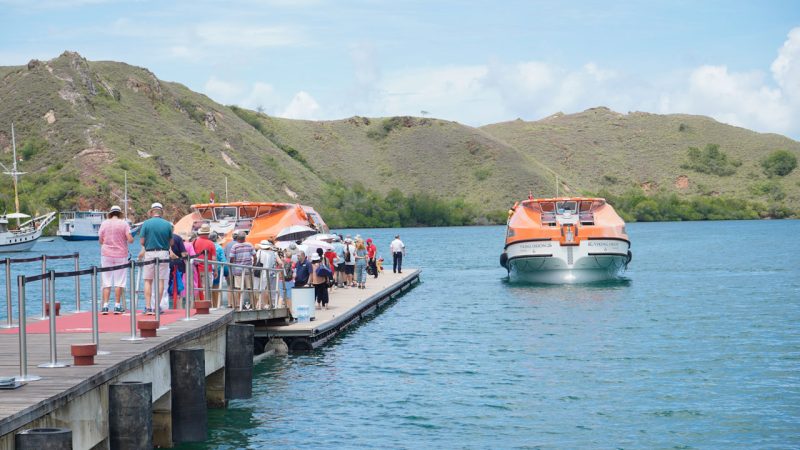
- Observe a few things at the dock
That list is short. It is short because the honest version is short, and a longer one would imply a level of verification that is not actually available to you.
What to ask before you book
These questions can be answered by any operator, and the answers are comparable across all of them.
- What is the name of the boat I will be on? The single most useful question. It moves the conversation from a category to a specific vessel.
- What documentation does the boat hold for carrying passengers? You are not asking to inspect papers. You are asking whether the operator can explain what the vessel has.
- How many passengers will be aboard, and what is the boat approved to carry? Capacity is an active enforcement concern, and it is reasonable to ask.
- Are life jackets provided for every passenger, and where are they kept?
- Who is the crew, and how many people are aboard working?
- What happens if the weather changes, and who makes that call? A clear answer tells you the operator has thought about it.
- How is park entry arranged? Practical rather than safety-related, but it belongs in the same conversation.
What to look for at the dock
Four things, all observable without any technical knowledge.
The boat’s name. Check that it matches what you were told when booking. If a different vessel has been substituted, that is worth asking about before you board rather than afterwards.
Life jackets. Whether they are present, whether there appear to be enough for everyone aboard, and whether they are accessible rather than stowed somewhere unreachable.
Passenger numbers. Whether the number of people boarding matches what you were sold.
A safety briefing. Whether the crew explain anything before departure.
None of these tells you whether a boat is seaworthy. They tell you whether the basics that are visible have been attended to, which is a different and more modest thing.
How to read the answers
The useful signal is not whether an operator’s answers are reassuring. Anyone can be reassuring.
What matters is whether the answers are clear, specific and consistent. An operator who names the vessel, explains what documentation it holds, and states passenger numbers without hesitation is behaving normally. That is the ordinary conduct of a company that knows its own boats.
Vagueness reads differently. An operator who will not identify the specific vessel, changes the answer between conversations, or declines to discuss documentation at all has told you something about how they communicate.
It has not told you the boat is unsafe. There may be a straightforward explanation, including a language barrier or a booking agent who genuinely does not know. But it is a reason to ask again, ask someone else at the company, or look at another option.
For a broader guide to assessing the company itself, rather than the vessel, see our guide to how to choose a Komodo boat operator.
What you cannot check
Being clear about this matters more than lengthening the checklist.
As a traveller, you cannot verify design approval or construction standards, stability calculations or load limits, crew certification, whether certificates are current, or the technical seaworthiness of the vessel.
These require professional competence and access that visitors do not have. You should not try to assess them. Looking at an engine or a hull and forming a judgment is not a meaningful check, and treating it as one gives false confidence.
What is available to you is the framework described above, the operator’s willingness to answer plainly, and the handful of things visible at the dock. That is genuinely less than most travellers would like. It is also the truth of the situation.
When to walk away
Not a dramatic decision, and not usually a single red flag.
Consider looking elsewhere if an operator will not tell you which boat you will be on, if answers change between conversations, if the vessel at the dock is not the one you booked and nobody will explain why, if more passengers board than you were told, or if you are asked to board a boat where life jackets are not evident.
None of these proves anything. Each is a reasonable point at which to ask more questions, and a reasonable point at which to decide you would rather book something else.
If you are travelling overnight, the threshold is worth setting slightly lower, simply because you will be aboard longer and further from Labuan Bajo. The differences between a day trip and an overnight liveaboard are covered separately.
A short pre-booking checklist
- The boat’s name, not just a category
- What documentation the operator says the vessel holds
- Passenger numbers against approved capacity
- Life jackets for everyone, and where they are
- Crew numbers
- Who decides in bad weather
- How park entry is handled
- At the dock: name matches, life jackets visible, passenger numbers as expected, briefing given
Eight items. If an operator handles them clearly, you have learned what is realistically available to learn.
Frequently asked questions
That is not a question with a single answer. A regulatory framework exists, covering seaworthiness, construction, crewing, and sailing approval, and it is actively enforced through inspections and document checks. Standards vary across a fleet of around 350 vessels. The practical approach is to establish which boat you will be on and ask the questions above, rather than looking for a general verdict.
Broadly, two things: maritime approval covering the vessel’s seaworthiness plus sailing approval from the harbourmaster for the departure, and separately, tourism business and transport operating licensing. The specific documents are a matter for the operator and the authorities, and this guide does not list document names it has not verified.
No public register was identified where a traveller can look up a vessel’s certification. What you can do is ask the operator to explain what the boat holds, and note whether the answer is clear and specific.
The name of the boat, what documentation it holds, how many passengers will be aboard against approved capacity, whether life jackets are provided for everyone, who the crew are, and who decides if the weather changes.
Leave a reply