
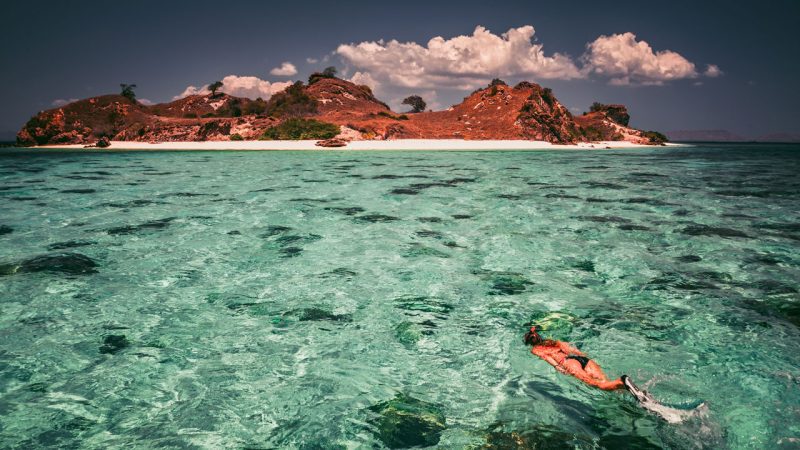
Snorkelling is a common part of Komodo boat trips, usually as a stop between islands rather than as something you choose separately.
The experience can be straightforward, but conditions in the park vary more than the standard description suggests, and the park’s own marine authority has said plainly that some sites have currents too strong for snorkelling at all.
This guide is about that variation: what snorkelling here involves, why currents matter, whether it suits your swimming ability, and what to establish before you go in. It is not a list of sites.
For the wider picture, see our Komodo National Park section.
What snorkelling here involves
Snorkelling in Komodo is done from a boat. You anchor or drift near a site, enter from the deck or a tender, and swim at the surface looking down.
Many snorkelling stops are accessed directly from a boat, so you may enter the water without a seabed underfoot. That makes open-water conditions an important part of the experience.
Snorkelling stops are typically fitted between other parts of the trip. The park authority requires visitors to be accompanied by a guide, and a briefing on conduct and what to expect should precede the activity.
Why currents matter
This is the part that distinguishes Komodo from calmer snorkelling destinations, and it comes from the park itself rather than from a guidebook.
The waters of the park are affected by tidal movement between islands and channels. That helps explain why conditions can vary significantly from one site to another and why current strength is an important consideration for snorkellers.
Not every site is snorkellable
In April 2026, the head of the marine division at the Komodo National Park authority stated the position directly: the park has dozens of dive sites, and not all of them can be used for snorkelling, because some have very strong currents.
That is worth sitting with, because it contradicts an assumption built into how these trips are sold. A site being famous, or being on a boat’s route, does not make it suitable for swimming at the surface. Diving and snorkelling are not interchangeable uses of the same location.
The authority named Batu Bolong, Crystal Rock, and Castle Rock among the sites where currents are strong and management attention is focused. Those names appear here as illustrations of conditions, not as suggestions.
What varies between sites
Sites differ in current strength, in how exposed they are, and in how conditions change with the tide. The park authority describes each dive point as having its own characteristics and current strength, which is why it strongly recommends using a guide rather than relying on your own reading of the water.
Conditions also vary on the day. A site that is comfortable on one visit can be moving fast on another, and operators may substitute a different stop when the planned one is unsuitable. Weather and sea state affect this too; our guide to the best time to visit covers how conditions vary through the year.
The practical consequence is that a site name alone does not tell you whether the conditions will suit you that day. What matters is the condition of that site when you are there.
Do you need to be a strong swimmer?
Not necessarily, but you do need to be honest about your comfort in open water, which is a different thing from being able to swim.
Entering from a boat with no seabed underfoot is unfamiliar to many people, and current adds a further element: you may need to swim against it, or be moved by it further than you intended. Someone who swims comfortably in a pool may find that harder than they expect.
There is no single standard here, and no blanket answer about who can or cannot snorkel in the park. What can be said is that conditions vary, that some sites are unsuitable, and that the sensible approach is to establish what you are getting into before you get in.
If you are not a confident swimmer
Say so, before the trip and again at the stop. It is a normal thing to raise, and crews deal with it routinely.
Ask what supervision is available, whether a buoyancy aid can be provided, and whether the planned site suits someone less confident. Whether flotation is available is an operator matter rather than a park rule, so it needs asking rather than assuming.
You can also choose to stay aboard for a stop that does not suit you.
Snorkelling with children
Ask about specific stops rather than the trip as a whole. Suitability depends on the site and the conditions on the day, not on the itinerary label.
Worth establishing: what flotation is available in child sizes, whether a crew member will stay with children in the water, and whether the operator will suggest an alternative if a stop is unsuitable. Answers vary between operators, and a clear answer is itself informative.
Manta encounters
Snorkelling with manta rays is a common reason for interest in the park’s water, and it deserves a straight account.
Encounters are possible, and they are not guaranteed. Mantas are wild animals in open water, and whether they are present at a given site on a given day is not something an operator controls.
Timing is also less settled than published guidance suggests. Sources disagree substantially about which months offer the best chance, and no authoritative source resolving the question was found. This guide does not publish a manta season, because the available claims do not agree and most come from businesses selling the trip.
Manta sites also tend to be places where current is a factor. The suitability question above applies to them at least as much as anywhere else.
What operators provide, and what varies
Several things that shape a snorkelling stop are operator decisions rather than park rules, and they differ:
- Equipment. Whether masks, snorkels and fins are provided, and their condition
- Briefing. How much is explained before people get in, including what the current is doing
- Supervision. Whether someone is in the water, watching from the deck, or neither
- Buoyancy aids. Whether they are available, and in what sizes
- Judgment. Whether an operator will skip or substitute a stop when conditions are unsuitable
None of this is standardised, and price is not a reliable indicator of any of it. Our guide to what to check with an operator covers how to assess a company more generally.
What to ask before you get in
A short list, all answerable, and all more useful than a site name.
- What are the conditions here today, and is there much current?
- Is this site suitable for snorkelling in these conditions?
- What supervision will there be while we are in the water?
- What equipment is provided, and are buoyancy aids available?
- How will the group be managed — where do we enter, and where do we return?
- What happens if conditions are not suitable?
Clear answers to these questions can help you understand what to expect before you enter the water and whether the planned stop is suitable for your group.
Snorkelling and diving are not the same activity
The two share sites but are managed differently.
In April 2026, the park authority introduced a minimum interval between successive diving groups entering the same site, to reduce crowding at popular points. Reporting described this as a twenty-minute limit on diving itself, and the authority publicly corrected that: it is an interval between groups, not a restriction on how long anyone spends underwater.
It applies to diving. The park authority confirmed that snorkelling and surface swimming are not subject to it.
Looking after the reef
The park sets conduct rules, and several apply directly to snorkelling. The authority’s published guidance for visitors includes:
- Do not wear fins in shallow snorkelling areas, because they damage coral
- Do not touch marine life
- Do not feed wildlife
- Do not remove anything from the park, including coral and shells
- Visitors should be accompanied by a guide
The fins rule is specific: in shallow water over reef, fins can damage coral without the swimmer necessarily noticing.
The park publishes a visitor protocol setting out rules for visitors and operators, with a sanctions framework attached. It is worth being aware that these are rules rather than suggestions.
How snorkelling fits into a trip
Snorkelling stops are a standard component of Komodo boat trips rather than something arranged separately, and how many you get depends on the itinerary you have booked.
Our guide to Komodo itineraries covers how trips are commonly structured. Park entry applies to your visit in the usual way, and our guide to park entry and reservations covers how that works.
The planning point worth carrying: because conditions and suitability vary by site and by day, the useful question to ask an operator is not how many snorkelling stops there are, but how they decide whether a stop goes ahead.
Frequently asked questions
It depends on the site and the conditions rather than on the park as a whole. Some sites have currents too strong for snorkelling, according to the park authority. Beginners should say so in advance, ask about supervision and flotation, and be willing to sit out a stop that does not suit them.
You need to be comfortable in open water, entering from a boat with no seabed underfoot. That is a different thing from swimming ability in a pool. Current can also require more effort than expected.
They vary considerably between sites and with the tide. The park authority has stated that some dive sites are unsuitable for snorkelling because currents are very strong, and it recommends using a guide given how much conditions differ.
It depends on the specific stop and the day. Ask about flotation in child sizes, whether a crew member will stay with children in the water, and what the operator does if a site is unsuitable.
Current conditions at that site today, whether it is suitable for snorkelling, what supervision and equipment are provided, how the group will be managed, and what happens if conditions are not suitable.
No. The park’s minimum interval between successive diving groups at the same site applies to diving only. The authority has confirmed that snorkelling and surface swimming are not subject to it.

Leave a reply