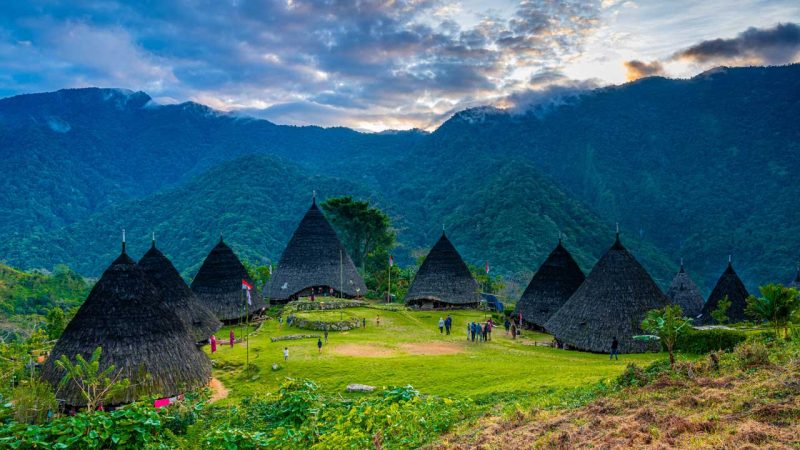
Wae Rebo is a village of conical thatched houses in the mountains of Manggarai on Flores. Vehicles can go as far as Denge; the rest of the way is on foot. This page explains what Wae Rebo is, what its Mbaru Niang houses and 2012 award mean, who manages the village, how access works, what visitors do and where they stay, and why the village sometimes closes. It does not give fees or tours.
What Wae Rebo is and where it lies
Wae Rebo lies in Satar Lenda village, in the Satarmese Barat district of Manggarai Regency, East Nusa Tenggara. Indonesia’s official tourism site places it at about 1,100 metres above sea level, in mountains and dense tropical forest.
The same site says seven Mbaru Niang houses stand in a circle at the centre of the village and gives the population as around 1,200 people. According to oral tradition, the village was founded by Empo Maro, an ancestor said to have come from Minangkabau in West Sumatra.
The Mbaru Niang houses and the 2012 award
Mbaru Niang are tall, conical houses thatched with lontar palm leaves from the roof down to the ground. Wae Rebo is described as the last place where this house type is still maintained.
In 2012 the village received the Award of Excellence in the UNESCO Asia-Pacific Awards for Cultural Heritage Conservation, announced in Bangkok on 27 August 2012. The award recognised the community’s rebuilding of the Mbaru Niang houses.
This is a conservation award. It is not an inscription on UNESCO’s World Heritage List, although some reports describe it that way. The official tourism site also lists two later recognitions, ISTA 2018 and the ASEAN Community Based Tourism award in 2023.
Who manages the village and the rules
Wae Rebo is managed by the Lembaga Pelestari Budaya Waerebo (LPBW), a cultural preservation body formally launched in 2012 with an advisory council drawn from eight lineages. The village has a guard post that provides information on its rules and tickets.
One rule is widely reported. Visitors may not trek up to the village after 16.00 WITA. LPBW chair Mikael Tonso said in April 2025 that the rule had been in place since 2022 and was being restated because many visitors ignored it, for the safety and comfort of guests and of the community.
Getting there: from Labuan Bajo to Denge
The road ends at Denge, and the walk to Wae Rebo starts from there. The official tourism site describes the road journey from Labuan Bajo to Denge as taking about five to six hours; a news report puts it at about five hours. The route runs through Ruteng, a town on the Trans-Flores route, and on towards Dintor before reaching Denge.
Walking time is harder to pin down. Pages on the official tourism site give about two hours, two to three hours and three to four hours for the walk from Denge, and other sources give different distances. This page does not repeat a distance because the figures do not agree. LPBW can give current guidance on the trail.
Other inland places near Labuan Bajo are covered in inland villages and waterfalls around Labuan Bajo.
Staying in the village and what visitors do
Indonesia’s official tourism site lists staying overnight in a Mbaru Niang among the things visitors can do, for one to two days. It describes the lodging as a homestay that uses a traditional house without changing its form or function, and lists four public toilets and the guard post among the village’s facilities, with clean water from mountain springs. A separate article on the same site notes minimal internet coverage and limited electricity.
The other activities the site lists are learning about the community’s customs and way of life, sitting and talking with villagers, walking the forest trail and birdwatching in the surrounding conservation forest. The Penti thanksgiving ritual can be seen if a visit coincides with it, although the village has also closed to visitors during Penti, as the status note below shows.
Arrangements and charges are set by LPBW, so confirm them before you go.
Why the village sometimes closes
The trail climbs through forested slopes that are prone to landslides, and heavy rain can make it unsafe. LPBW closes the village to visitors when conditions are judged unsafe, and also for community events. For general advice on travelling in the region, see general travel health and safety advice for the region.
Wae Rebo status (checked 20 November 2026)
Wae Rebo has closed several times in 2026. Reports describe closures from 15 January to 9 February after bad weather and landslides, from 13 to 25 May after a landslide blocked the trekking path, and from 20 July to 1 August after heavy rain. After the earthquake of 15 August, the village closed because of landslide risk on the trek and reopened on a limited basis on 1 September. On 9 November, CNN Indonesia reported a temporary closure for the Penti ritual on 15–16 November.
The LPBW chair said visits can be stopped again at any time. The latest report found is dated 9 November 2026, and no report on the situation after the Penti closure was found. This box is not a statement of current conditions.
Frequently asked questions
Wae Rebo is in Satar Lenda village, Satarmese Barat district, Manggarai Regency, on the island of Flores in East Nusa Tenggara.
No. In 2012 it received the Award of Excellence in the UNESCO Asia-Pacific Awards for Cultural Heritage Conservation, which recognises conservation work. It is not listed as a World Heritage property.
Sources disagree. Pages on Indonesia’s official tourism site give about two hours, two to three hours and three to four hours from Denge. Ask the village managers for current guidance before you go.
The official tourism site gives about five to six hours by road from Labuan Bajo to Denge, the last village vehicles can reach. The walk to Wae Rebo starts there.
No. The village’s rule, in place since 2022 and restated in April 2025, bars trekking up to Wae Rebo after 16.00 WITA.
The latest report found, dated 9 November 2026, announced a temporary closure on 15–16 November for the Penti ritual. The village has closed several times in 2026 and can close again at short notice, so check with the village managers shortly before you travel.
Yes. Indonesia’s official tourism site lists an overnight stay in a Mbaru Niang among visitor activities, with lodging in a traditional house. Check current arrangements with the village managers, LPBW.