Komodo National Park is best known for the Komodo dragon, but UNESCO’s description of the park also lists other land animals and a marine environment of coral reefs, whales, dolphins, dugongs and sea turtles. This page gives an attributed overview of those groups, on land and in the sea. It is not a species checklist, and it does not give sighting advice or dive sites.
Why the park holds more than the dragon
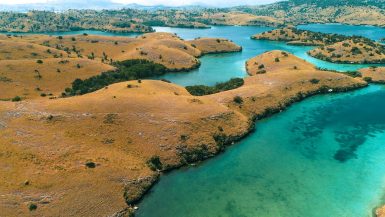
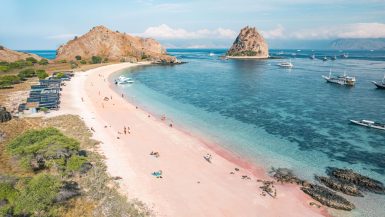
UNESCO describes the park as a landscape of contrasts: rugged, dry hillsides, pockets of thorny vegetation, white sandy beaches and blue water over coral. It says that besides the Komodo dragon the park provides a refuge for other notable land species, and that its coral reefs host a great diversity of species.
IUCN’s World Heritage Outlook adds the geographical setting. The park lies where two continental plates meet, in what the Outlook calls a “shatter belt” within the Wallacea region, between Australian and Sunda ecosystems. UNESCO’s description records that the park was declared a national park in March 1980, and IUCN gives its World Heritage inscription as 1991.
On land
The dragon. The Komodo dragon is the park’s best-known animal. Its biology, numbers and where it lives are covered in our Komodo dragon guide, so this page does not repeat them.
Mammals. UNESCO’s description lists seven land mammal species in the park, including an endemic rat, the crab-eating macaque and the Timor deer. Republika’s report of 11 August 2017 on a statement by the head of the park authority (BTNK) lists deer, buffalo, horses, wild boar, rats and other small animals among the dragon’s food sources. That is the only list of those animals used on this page, and it dates from 2017.
Birds. UNESCO records 72 bird species, including the lesser sulphur-crested cockatoo, the orange-footed scrub fowl and the noisy friarbird. The lesser sulphur-crested cockatoo (Cacatua sulphurea) is also called the yellow-crested cockatoo, the name our Rinca Island guide uses, following BTNK.
Snakes. The blue pit viper (Trimeresurus insularis), also called the white-lipped island pit viper, is a venomous snake found on Komodo Island. Australian Geographic reported in 2017, citing Stephen Mahony of the Australian Museum, that the blue form is rare and that both green and blue individuals have been seen on Komodo. Mongabay Indonesia described the species in 2025 as a tree-dwelling pit viper with haemotoxic venom.
Where a visitor might see any of these animals is not covered here, and no sighting can be promised.
In the water
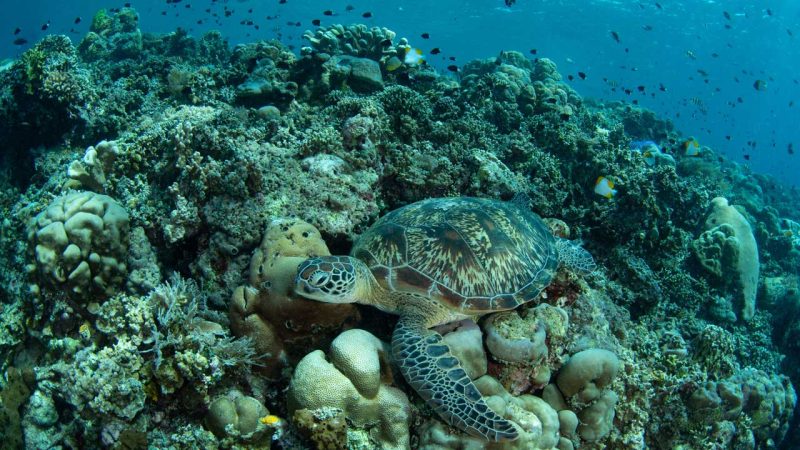
UNESCO and IUCN list the same marine mammals: the blue whale, the sperm whale, 10 dolphin species and the dugong. Both give five species of sea turtle. UNESCO describes the reefs as diverse, and IUCN describes the park as one of the richest marine sites in the Indo-Pacific.
IUCN also rates the park’s marine biodiversity as Data Deficient, because there is no long-term marine monitoring programme. The lists above therefore describe what has been recorded, not a current count.
Reef manta rays. The IUCN SSC Shark Specialist Group lists the Komodo Islands as an Important Shark and Ray Area, in a factsheet published in 2024. The reef manta ray (Mobula alfredi) is its qualifying species and is assessed as Vulnerable on the IUCN Red List. Our guide to the park’s islands has a short note on reef manta rays and the name Manta Point.
Pressures on the wildlife
UNESCO’s description, which shows no date, states that illegal fishing and poaching remain the main threats, that tourism growth is a major management concern and that depletion of dragon prey species has been a focus.
IUCN’s Conservation Outlook assessment, finalised on 11 October 2025, gives the park an overall rating of Significant concern. Among the marine threats it lists boat anchoring that can damage reefs and past destructive fishing. It says illegal fishing appears to have improved but that data is lacking.
Seeing wildlife in the park
The animals above are wild, and whether any species appears on a given trip cannot be promised. The park authority’s visitor protocol lists feeding animals, and touching them or getting too close to them, among prohibited acts. Our guide to the rules for visiting the park sets out the protocol.
Frequently asked questions
According to UNESCO’s description, the park is home to the Komodo dragon, seven land mammal species including an endemic rat, the crab-eating macaque and the Timor deer, and 72 bird species. UNESCO and IUCN also list whales, dolphins, dugongs and sea turtles in its waters.
No. UNESCO also describes the park’s reefs and marine animals. IUCN says the marine data is deficient because there is no long-term marine monitoring programme.
UNESCO and IUCN list the blue whale, the sperm whale and 10 dolphin species as recorded in the park’s waters. Whether any can be seen on a trip cannot be promised.
UNESCO and IUCN list the dugong and five species of sea turtle. They are recorded in the park, and sightings cannot be promised.
Yes. Australian Geographic and Mongabay Indonesia describe the blue pit viper, a venomous species, on Komodo Island. The park’s visitor protocol prohibits touching animals or getting too close to them.
Not by promise. The animals are wild, and sightings vary. The park’s visitor protocol prohibits feeding animals and touching them or getting too close to them.