“Manta Point” is one of the most searched names in Komodo National Park, yet it is not a name the park authority uses for a destination. It is a tourism and dive name, and it is used for more than one place in Indonesia. This page sets out what can be said about the Komodo site with sources, where descriptions differ, and what cannot be promised. The park’s other islands and sites are covered in the guide to the park’s islands.
Which place the name refers to
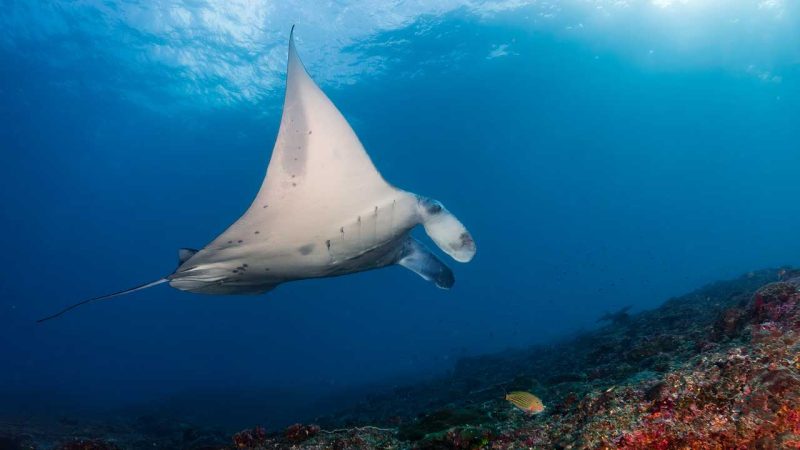
In Komodo National Park, “Manta Point” is generally used for a reef called Karang Makassar. WWF Indonesia lists the site as “Manta Point (Makassar Coral)” among its manta and shark monitoring sites, and a WWF article quotes the head of the park naming Karang Makassar and Manta Alley as popular manta sites. A peer-reviewed study published in 2022, whose authors include a Komodo National Park staff member, uses the name Karang Makassar for the same central-park site. It does not use “Manta Point” for it.
Descriptions of where the site lies differ. The national news agency ANTARA described it in 2017 as near Rinca. Tour pages describe it as east of Komodo Island or between Komodo and Rinca. The 2022 study places it in the central region of the park. This page does not give directions or travel times, because none of these sources is a map or an official notice.
The name causes confusion for two reasons. Manta Point is also the name of a well-known site off Nusa Penida in Bali, which the same study uses as a comparison. And at least one dive listing uses “Manta Point (Nusa Kode)” for a different site in the south of the park. Anyone comparing information should check which site a page means.
What the research found at the site
The 2022 study used a library of photographs from researchers and divers. It identified 1,104 individual reef manta rays across the park between 2004 and 2018, from 4,163 sightings, and about 95 per cent of the data came from citizen science. It studied four sites: Cauldron in the north, Karang Makassar and Mawan in the centre, and Manta Alley in the south-west.
For Karang Makassar the study describes a shallow, gently sloping rubble field about 1.5 kilometres long with patches of reef and coral heads. One dive information site gives a larger size, about 3 kilometres by 400 to 500 metres. The figures differ, and the study is the source used here. The study classes it as a cleaning station, where manta rays stay while small fish remove parasites, and cleaning was the most common behaviour recorded there. Feeding was recorded too, with up to 30 individuals feeding together during the north-west monsoon. Courtship was recorded at Karang Makassar, Mawan and Manta Alley.
Many of the animals returned. About 72 per cent of individuals were seen again within the three core sites, and some travelled far: eleven were matched at Nusa Penida, around 450 kilometres away.
The study also found a seasonal pattern. Visits to the central sites rose in the north-west monsoon, from November to April, while Manta Alley was visited more from May to October. Central-site sightings were lower in August and September. A university press release on the study says manta rays are present in the park year-round. That describes the population, not a guarantee for any day or site; the snorkelling guide explains why encounters cannot be promised.
Tourism pressure and the limits
The same study counted tour boats at the sites. At Karang Makassar and Mawan combined, boats per survey rose by 34 per cent from 2014 to 2017, and counts at Karang Makassar in July and August were about double the average for the rest of the year. It reported that from September 2019 Karang Makassar was limited to 32 boats, each carrying at most ten divers. As of 22 November 2026 this page has not found a current statement confirming that limit, so it should be read as the position at the time of the study.
Two newer measures apply to the park generally. In April 2026 the head of the park authority said that boats diving at a site must keep a 20-minute interval, as reported by detikBali. The park authority has also applied a limit of 1,000 visitors a day since 1 April 2026, as ANTARA reported. Neither is specific to this reef, and rules can change; check the park authority’s current notices before travelling.
Protection
Indonesia’s Ministry of Marine Affairs and Fisheries gave both manta species full protection in Decree 4/KEPMEN-KP/2014 of 27 January 2014, covering the whole life cycle and body parts. The study cites a 2013 West Manggarai regulation banning shark and manta fishing, which came before the national decree. A later ministry decree of 2021 restated protection for a list of 20 fish species. This page has not confirmed whether it replaced the 2014 decree, so it refers to the 2014 decree only. The reef manta ray is also one of the animals covered in the guide to wildlife in the park.
What cannot be promised
The sources here do not allow a promise that manta rays will be present on a given day, that a boat will stop at this site, or that the number of boats will be small. Seasonal patterns come from a study of identified animals, not from a forecast. Closures and sailing suspensions can also change which sites are reachable.
Frequently asked questions
In Komodo National Park the name is generally used for Karang Makassar, according to WWF Indonesia and the 2022 study. It is not a name on the park authority’s destination list, and other sites elsewhere also use it. As of 22 November 2026.
A university press release on the 2022 study says they are present in the park year-round. The study found more visits to the central sites from November to April, fewer in August and September, and more at Manta Alley from May to October. No day or site is guaranteed. As of 22 November 2026.
Yes. Decree 4/KEPMEN-KP/2014 gave both manta species full protection from 27 January 2014. As of 22 November 2026 this page has not confirmed whether a later decree replaced it.
A 2022 study reported a limit of 32 boats, each with at most ten divers, at Karang Makassar from September 2019. As of 22 November 2026 no current statement confirming it was found. A 20-minute interval between boats at dive sites and a park-wide limit of 1,000 visitors a day were reported in 2026.